




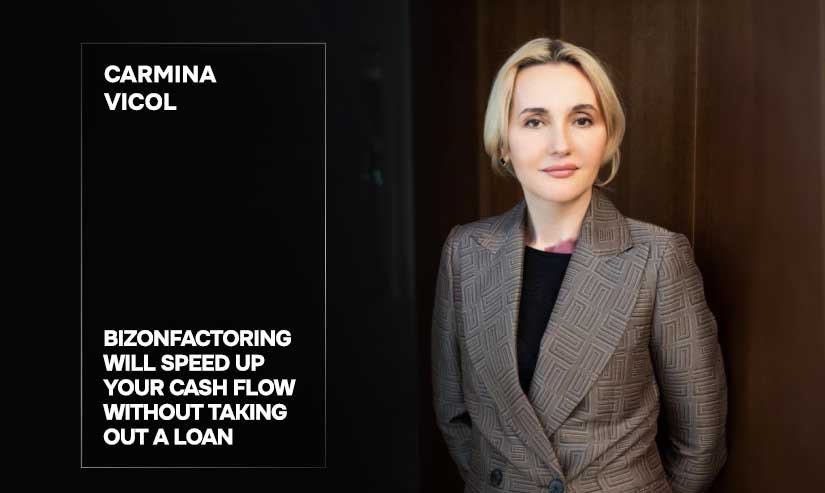

An interview with Carmina Vicol, CEO of the financial company Prime Capital
Carmina, hello. Let’s start with the question I asked you a few days ago when we ran into each other: “Why is there often a car parked outside Prime Capital’s office with Bizonfactoring branding? You’re not renting out the office, are you?”
Let me answer you the same way I did then. Bizonfactoring is a separate business line under Prime Capital. It’s so important and promising for us that we decided to create a distinct brand for it. It’s a shame I can’t include the logo in this interview—then the product’s main idea would be immediately clear: “switch your business on” — biz-on. And no one will catch up to you.
Did you recently get into factoring?
More like you recently noticed the branded car. We actually launched our factoring service back during the pandemic. It was a time when many people had a chance to reflect and start exploring new strategic directions. That’s when we got into factoring. To be honest, as a finance professional, I had been thinking about this area since 2007. But then came the 2008–2009 financial crisis, and the idea had to be shelved.
For a whole decade…
Some things just need time to ripen. Factoring was growing rapidly in Europe, and I found myself increasingly in touch with international factoring operators. I really liked their business model. At one point, our team decided to return to the idea and start offering factoring services. At first, we considered acquiring an existing factoring platform, but then we made a bold decision—to develop our own platform from scratch.
So you built your own software?
Yes. Bizonfactoring.md lets you do everything online. In fact, we might never even meet a client in person. The platform allows businesses to register remotely, sign a framework agreement, and start submitting invoices. We use electronic signatures, we provide all necessary consultations online, and every client has access to their full transaction history in their personal dashboard.
If we treat your platform as a test of how ready Moldovan businesses are for digitalization, are many of them starting to work with you remotely?
At first, many clients preferred to meet in person for the initial contact, but all the actual operations are done online—it's just more convenient and faster that way. Lately, though, we’re seeing more and more clients choosing to begin remotely, too. What’s most important to us is that potential clients clearly understand what the product is.
The product? Factoring isn't a loan—it's a debt purchase with a small fee, right?
It is a purchase, but not a collection! That’s a crucial distinction. A lot of people still confuse factoring with debt collectors. “Oh! You buy unpaid debts? I’ve got a few invoices that haven’t been paid in years!” No—that’s not it.
Then go ahead and clarify the definition of factoring…
Here’s a simple example. Picture yourself running your business, offering your services. Let’s say you spent a month writing a series of interviews for a large client. But their contract says they’ll pay within 60 or 90 days. You've done the work, you need the money now for whatever reason, but you’ll have to wait quite a while for the payment—even though you’re sure it will come.
That hits close to home—especially when working with big international companies.
It’s not just international ones. Say you're delivering food products to retail chains—those also tend to have long payment terms for suppliers.
So let me phrase it: factoring is the purchase of a debt whose payment term hasn’t come due yet?
Exactly. You’ve provided services or delivered goods. You have a contract with a financially stable buyer. The payment term is 30, 60, even 120 days out. But you need the money now. You come to us, and we buy the invoice from you. From then on, we collect the payment from your debtor. We don’t pressure them—we just notify them that the payment rights have been transferred to us, and that they should make the payment to our account.
How do debtors react to your calls and messages?
They’re completely fine with it. Most of them are already familiar with factoring, and if they’re not, we explain everything.
You said “up to 120 days”?
That’s the maximum payment term we allow under our factoring model. Anything beyond that would fall under lending. In that case, the business would have to submit a completely different set of documents. With factoring, the paperwork is extremely simplified. A business might not qualify for a loan due to its financials, but factoring is a whole different story.
Right, because what matters to you is the reliability of the payer, not the business itself. So what are the financial terms for your factoring services?
As soon as an invoice is submitted, we pay out 90% of its value. The remaining 10% stays with us until we receive payment. Then we deduct our commission—around 4 to 5%—and transfer the rest to our client.
What determines that “around 4 to 5%” rate?
Primarily the payment term of the invoice we buy. There’s a difference between 30 days and 120 days. But what really matters for our client is this: they stabilize their cash flow and avoid having to urgently look for a loan to cover expenses. We’ve even had cases where a client didn’t necessarily need the money right away—but they were suddenly offered a product or service at a steep discount if paid upfront. So on one hand, they’re paying a 5% factoring fee, and on the other, they’re saving 20% on a purchase. Factoring becomes a no-brainer in that case.
What’s the maximum amount you’re able to factor?
We haven’t set a specific cap. In practice, we’ve done deals up to one million euros. That’s more than enough, since we’re talking about invoices for delivered goods or services.
Only for the domestic market?
For now, yes. We’re planning to offer export factoring as well, but a bit later—possibly starting next year.
Do you offer any perks for loyal clients? After all, factoring can become an integral part of a company’s financial operations. Comparing the fee to the benefits of accelerating turnover, it often makes sense to prioritize cash flow. It allows you to pay salaries, taxes, and other obligations on time—and like you said, take advantage of early payment discounts. There are plenty of reasons to make factoring a regular tool…
You’re thinking in the right direction. From what we’ve seen, factoring has one of the highest client loyalty rates. Up to 98% of our clients come back. For example, our very first client—from back when we were just testing the service—is still actively using factoring with us. That’s why we introduced a loyalty cashback program: every sixth invoice is essentially processed free of charge.
In addition to standard factoring, we also offer reverse factoring—where the supplier agrees to cover the payment if the buyer fails to pay on time. In those cases, our commission is lower because the risk is lower.
Did we miss anything in this conversation?
We’ve covered the main points. But I do want to stress again: factoring is a very convenient financial tool for gaining better control over your cash flow and speeding up your turnover. Even more importantly, when a client really understands how it works, they can build the factoring cost into their pricing—and win again. Factoring gives you financial agility, which is absolutely critical in a world where external conditions change quickly. As you well know, that’s become the new normal.
Okay. Can we share the link to Bizonfactoring?
Absolutely. In fact, I would sincerely recommend that many businesses register and “test-drive” our service on a small invoice. That way, if there’s ever an urgent need, the path is already cleared, and funds can be received in just 1–2 hours. Better to have factoring ready at hand—even if you don’t need it right away.
Here’s the link: bizonfactoring.md


 Life Principles


