




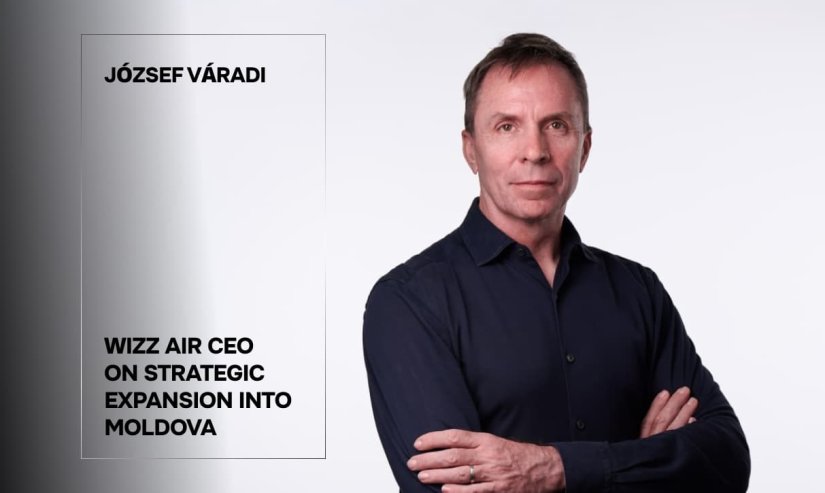

As Wizz Air expands across Central and Eastern Europe, Moldova represents a natural next step. A market where we can build infrastructure, stimulate demand, and strengthen European integration.
Good afternoon, József. May I briefly break the interview protocol?
Yes, sure.
I found out that you own a winery in Hungary, and since I’m from Moldova, wine is always a very relevant and special topic for us. Could you tell us a little about it?
Hungary has a long tradition of winemaking going back over 200 years. Historically, it was one of the largest wine producers in Europe, alongside France and Italy. The country is particularly known for its unique strengths in sweet wine production, which were highly valued by royal courts across Europe, including in Russia and France. In fact, a French king, Louis XIV, once described Tokaji Aszú, which is the region’s most prominent sweet wine, as “Wine of Kings, King of Wines”.
This legacy inspired me to contribute to the revival of Hungary’s winemaking heritage. In 2016, I established a family winery, exactly 10 years ago, and today we produce a range of high-quality wines, including sparkling, white, dry, and sweet varieties. Our goal is to bring Hungarian wines to a global audience. Most of our production is exported, primarily to Asia and, to a lesser extent, Western Europe. We are very proud of this achievement.
I should mention that this is more of a passion project, which of course is not comparable to Wizz Air. That said, we are very proud of it, it’s a rewarding business that we are passionate about. The brand is called Juliet Victor, derived from my initials, József Váradi - J.V. In aviation phonetics, “Juliet” stands for J and “Victor” for V, which is the phonetic alphabet pilots use when communicating with air traffic control.
Of course, wine is a subject one could discuss endlessly and we certainly could, but that, in essence, is our story.
Have you had a chance to explore Moldovan wines?
I have, and I think you produce very good wines. One key difference between Moldova and Hungary is the climate. Moldova’s climate is particularly well suited for red wines, whereas in Tokaj, that is considered a cooler, more mountainous region by Hungarian standards, the conditions are better suited for white wines. That’s why we primarily produce white wines, including all of our sweet varieties, which are made from white grapes. Moldova probably has a better climate for red wines.
But, of course I have tasted Moldovan wines, and I genuinely enjoy them.
In 2025–2026, Wizz Air made a significant expansion in Moldova, increasing the number of aircraft based in Chișinău. What factors convinced you that now is the right moment to turn Chișinău into one of the airline’s key hubs in the region?
Wizz Air is very much a product of European expansion and integration, and in a way, we feel a responsibility to carry the European flag into emerging markets such as this one.
One senior official of the European Commission told me a few months ago that Wizz Air is seen as the expansion airline of the European Union. Indeed, if I look at all the candidate countries for EU membership, Wizz Air is a very significant airline in each of them. We are a critical infrastructure provider in these countries, and we tend to be the market leader in most of them, Moldova included.
We are also a very significant player in Romania, the largest airline in the country, with roughly a 50% market share. Geographically speaking, Moldova is a natural next step, given its strong links to Romania and its ambitions to join the European Union. As the leading low-cost airline driving development in Central and Eastern Europe, the “new Europe”, we felt this was the right strategic step for us. I believe this has been confirmed by the numbers and by the market’s positive response to our brand.
We have experienced some challenges due to the war, at times having to suspend and then resume operations. I hope the situation now remains stable so we can continue flying without disruption and avoid making any emergency decisions.
We are serious about Moldova. We are committed and are making significant investments in aircraft and human resources, including hiring local pilots and cabin crew. We are steadily building our presence in the country, and our brand, we believe, resonates well with the needs of the market and Moldovan customers. We can create strong infrastructure and significantly enhance connectivity between Moldova and the European Union.
As a team, we are very proud of what we have achieved so far, and we remain committed to further expanding our presence in the country.
One of the broader challenges facing the aviation industry today is the growing number of flight delays, schedule changes, and cancellations. The reasons behind this are often understandable. But for passengers this creates uncertainty when planning their trips, and it can also generate negative publicity for airlines. What message would you like to send to Moldovan passengers today, and how can they rely on Wizz Air in the long term?
I can share some numbers. In terms of completion rate, completion means what percentage of the flights the airline publishes to the public in the schedule are actually operated. We are among the best in the European industry. We consistently rank either first or second, at the very top of the market. We operate around 99.7% of our scheduled flights and cancel three times fewer flights than the European average. When cancellations do occur, they are typically due to exceptional circumstances, such as severe weather, airport closures, or airspace restrictions, for example, in the context of a war. When operations are not affected by external factors, we perform very reliably. In terms of on-time performance, we are also performing well. While we may not always be the very best, we are consistently at the upper end of the industry.
It is a complex matter, as it involves various external factors such as weather, airspace closures, airport disruptions, as well as the condition of the fleet and the technical availability of aircraft. We have been investing significantly in additional spare capacity, including more backup aircraft. This allows us to respond effectively when an aircraft needs to be grounded for technical reasons, ensuring continuity of operations. We have stepped up our efforts in this area, investing hundreds of millions into additional aircraft and crew to strengthen operational resilience.
If I look at 2025, it marked a significant improvement compared to 2024. We faced challenges in 2023–2024, but since 2025 and continuing into 2026 we have been delivering much stronger reliability and operational performance.
It is important to remember the scale of disruptions we faced: the war in Ukraine, conflicts in the Middle East, and supply chain issues affecting aircraft engines. These required us to adjust capacity, ground aircraft, and modify schedules, making it a particularly challenging period. Today, the environment is still not perfect, but it is more predictable. More importantly, we have learned how to manage such situations more effectively. This should provide customers in Moldova with confidence that Wizz Air is a highly reliable airline.
Wizz Air is known for its ultra-low-cost model. At a time of global inflation and rising fuel prices, how are you still able to keep ticket prices from Chișinău starting at around €20–30?
If you look at how we operate, we are strongly focused on structural investments that improve the economics of the business. This essentially means achieving the lowest possible cost in the industry and passing those savings on to customers. In doing so, we stimulate demand and enable substantial growth. In Moldova, as you noted, 2025 was a year of significant expansion. We increased our presence in the country multiple times, and this growth is continuing into 2026. We are planning to grow capacity by around 60% this year compared to last year. Taken together, 2025–2026 represents a period of substantial growth in the market. This has only been possible because of the investments we have made in our fleet. In essence, we have focused on two key areas.
First, we are renewing our technology. In simple terms, we are at the forefront of adopting the latest innovations in aviation. In our case, this means the Airbus “new engine option” (NEO) technology, which delivers around 17% fuel savings. This is highly significant, as fuel typically accounts for about one-third of an airline’s total costs. By reducing fuel consumption, we lower our operating costs and pass those savings on to customers, helping to stimulate demand.
The second element is fleet upgauging. We are transitioning from the 180-seat Airbus A320 to the larger, 239-seat Airbus A321. By design, larger aircraft with higher seating density reduce unit costs per passenger, making operations more efficient.
Together, these two factors allow us to achieve very low unit costs and use those savings to grow the market. Both processes are ongoing, we continue to adopt new technology and transition to larger aircraft.
So when we are low-cost, we are low cost because of the structural investments we are making. Of course, as you see in the world today, there is a significant degree of unpredictability. As we speak, fuel prices are spiking as a result of the war in the Middle East. Oil prices are rising, and as a result, aviation fuel is also increasing. But I think this is temporary. To be honest, once this conflict is over, I believe the world will settle at a much lower input cost for fuel.
What we are really focused on is structural investment, factors that move the business forward in a sustainable way rather than simply being lucky or unlucky with the cost environment of the moment, such as fluctuations in fuel prices.
With the launch of new routes to Prague, Copenhagen, Nice in 2026, which audience are you primarily targeting the Moldovan diaspora travelling back home, or European tourists discovering Moldova for the first time?
We started operating 21 years ago, and our primary focus was to reunite families. Ensuring that the diaspora could stay connected to their home countries and travel to see loved ones. Over time, this naturally evolved as we began to recognize the tourism potential.
Today, we see Moldova not only as a market for connecting the diaspora, but also as an opportunity to develop inbound tourism, bringing more visitors into the country. As economic conditions improve, with GDP growth and increasing incomes, and as some members of the diaspora return or reinvest in their home country, we also expect stronger demand for leisure travel among local populations.
Typically, this begins with what we call a “visiting friends and relatives” (VFR) model. This then evolves into inbound tourism and outbound leisure travel. In some markets, as our product improves and flight frequencies increase, we also become attractive to business travelers, meeting their needs as well.
It is a gradual process - an evolution. In Moldova, we are already moving beyond the initial stage of diaspora connectivity. Increasingly, we are focusing on expanding both inbound and outbound leisure capacity.
Looking five years ahead, how do you see Chișinău Airport’s role in the region, and could it become a stronger bridge between the EU and its eastern neighbours with Wizz Air’s support?
You have a strong geographical position. Moldova can serve as a gateway between the European Union and the eastern part of the world. We are a point-to-point airline, not a connecting carrier, and we do not operate a hub-and-spoke model. Our focus will remain on point-to-point traffic. That said, any opportunities to expand our network further east would certainly be of interest to us. Typically, this kind of network development requires regulatory approvals, you need to be designated as an airline for those routes. With the European Union, Moldova benefits from an open skies agreement
So actually, it is fairly free to develop the network between the EU and Moldova. But the moment you want to fly outside the European Union, you are challenged by the bilateral nature of air service agreements between countries. But of course, we have a vested interest in pushing the boundaries and making sure that we are not only permitted to fly West, but also permitted to fly East. It's just a bigger challenge. It requires more work, more time, but definitely, we would be interested in that.
And we are, of course, interested in expanding our team in Moldova. In particular, we plan to increase the number of cabin crew by one third.
How would you summarize the interview, considering that it is primarily aimed at a Moldovan audience?
Wizz Air is in Moldova for the long run.
Wizz Air is in Moldova for market leadership.
Wizz Air is an economic engine for the Moldovan economy.
Wizz Air wants to be a good corporate citizen, aligned with the country’s agenda.
Wizz Air is in Moldova to create connectivity for Moldovan people living both in the country and abroad, as well as for tourists coming to Moldova.
We are the accession airline of the European Union, and We are very proud to fulfil that role.

 Life Principles


