




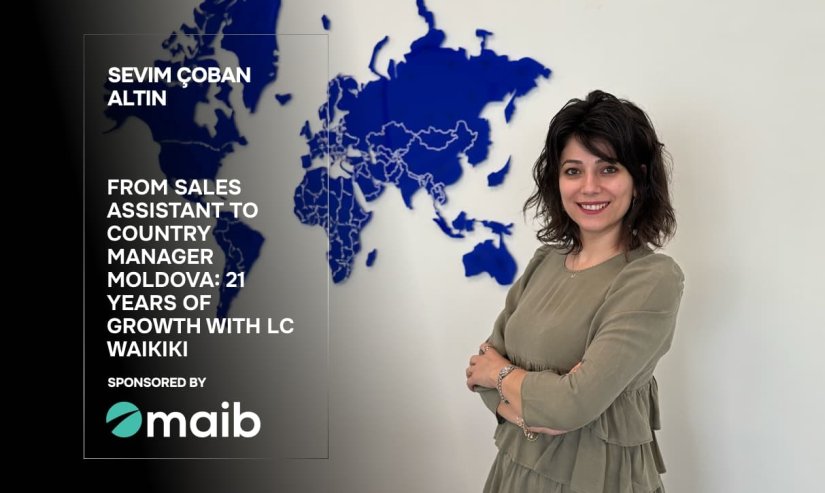

Interview with Sevim Çoban Altın, Country Manager Moldova at LC Waikiki. The interview was prepared with the support of maib.
Initially, LC Waikiki was a French company. Is that correct? Could you tell us about the history of the company and how it became Turkish-owned?
Yes, it was originally a French company. In 1997, it was acquired by a Turkish company that had previously been manufacturing products for the brand.
Recognizing the brand’s strong potential, the new owners decided to purchase all the rights. In a decisive move, they terminated the franchise agreements and transitioned to a fully direct retail operation.
There is a significant difference between franchise management and direct operation. In a franchise model, it is more difficult to fully implement and control the company’s vision, standards, and corporate culture. With direct operations, however, the brand’s mission, operational style, and customer experience can be reflected more clearly and consistently.
LC Waikiki was initially a children’s clothing brand, with no collections for adults. After acquiring the company, the new owners made a strategic decision to expand the product range to include men and women. At the time, the brand’s logo was a monkey, reflecting its focus on children. As part of the repositioning strategy, the logo and its colors were redesigned to align with the broader target audience and the company’s new direction. The transition was not easy. In Turkey, the brand had previously been positioned as a high-end label. However, the new ownership decided to reposition it as an affordable brand accessible to everyone. At the end of the 1990s and the beginning of the 2000s, the Turkish fashion retail market lacked affordable chain stores. Consumers typically had to choose between local bazaars and unbranded products on one side, and luxury brands on the other. There was no middle segment serving the growing middle class. The owners recognized this gap in the market. While maintaining product quality, they reduced prices and significantly expanded the collection range.
The first years were challenging, but once customers began visiting the stores and experienced the combination of quality, variety, and affordable pricing, the brand gained popularity.
The real growth phase began in 2004. In 2004, the company operated 59 stores in Turkey. Today, there are around 700 stores in Turkey alone. Globally, LC Waikiki operates approximately 1,200 stores across five continents and in 60 countries.
In which country did the company open its first store outside of Turkey?
We opened our first international store in 2009. After beginning our strong growth phase in 2004, we expanded beyond Turkey five years later. The first market we entered was Romania.
At that time, our Expansion General Manager was carefully analyzing potential markets. Based on the research, Romania was selected due to its market potential and cultural similarities, including comparable consumer habits and dressing styles. Shortly after Romania, we entered Kazakhstan, and from there our expansion continued globally.
We have now been present in Moldova for more than ten years. Our first store opened in Shopping MallDova, the country’s first shopping center. The store was highly successful from the beginning and remains one of our leading locations. At the time, its performance was considered a success not only locally, but also at the international level within the company.
Initially, Moldova was managed by our Romanian team. However, as sales continued to grow and customer interest increased, we recognized the market’s specific potential. As a result, we decided to manage Moldova separately from Romania. For the past five years, Moldova has been operated as an independent market within our structure.
How many stores do you currently operate in Moldova?
Currently, we operate 12 stores in Moldova. Six of them are in Chișinău, and the other six are in regional cities: two in Bălți, one in Ungheni (opened last summer), and one each in Cahul, Comrat, and Orhei.
This year, we plan to open another store in Căușeni and a second store in Chișinău in April. We are also looking to expand into other cities. For example, we are considering Edineț, where we have already visited several potential locations and are evaluating the best options. Our goal is to open a store there by the end of this year or the beginning of next year. Last year, we planned to enter Rezina, but the project could not proceed because the building structure was not suitable. Currently, we are collaborating with some local partners to open a store at the same location. By being next to each other, we aim to create a destination area for local residents. In smaller cities, where there are no shopping malls or entertainment centers, shopping often becomes the primary activity, and our presence adds value to the community.
Our expansion strategy focuses first on cities with higher populations. Soroca is also on our radar. We plan to evaluate the potential there before including it in our development plan.
Overall, our target is to grow to 20 stores in Moldova within the next two to three years.
In what year did you join the company?
I joined the company in 2004, when I was only 18 years old. Last year, the company celebrated employees who had reached their 10th and 20th anniversaries, and I was also recognized as part of that milestone.
At the time I joined, the company had 59 stores. I started as a sales assistant because I was 18 and attending university at the same time. I wanted to gain work experience, so I began my career on the sales floor.
I am from Antalya, Turkey, where I also completed my studies. While growing within the company, I was simultaneously finishing my education.
Could you share how your career progressed to your current role as Country Manager?
When I started as a sales assistant, my initial goal was simply to earn some money as a student. At that time, the fashion retail sector in Turkey had very few professionals. But when I joined the company, I immediately noticed the level of professionalism, it felt like another school that was teaching me the business from the ground up.
Early on, I decided I could grow within the company. I set a personal goal to become a manager. Within two years, I was promoted to second store manager and shortly after to first store manager.
I worked in Antalya for around nine to ten years. What kept me at the company for 21 years and allowed me to grow was the abundance of career opportunities. The company invested in its people. For example, I traveled to Istanbul for numerous training programs. In fact, the first time I ever flew on a plane was for a company training while I was still a sales assistant.
Each store would select promising employees for development programs. Promotions were not automatic; there was a structured training process, evaluations, and exams. Your manager would prepare you for future responsibilities, ensuring you were ready for the next step.
After nine years, having graduated from high school in English, I wanted to further develop my skills. I took an unpaid leave for seven months and went to the USA to complete additional training. After returning, I relocated to Istanbul and aimed to join the international side of the business.
By 2014, I was responsible for five countries: Romania, Moldova, Poland, Ukraine, and Belarus. I reported to the General Manager Assistant on sales, operations, and product issues, managing and supporting these markets from Istanbul. That same year, I also came to Moldova when we opened our first store there.
The company’s commitment to developing professional people and providing growth opportunities shaped my career. The training, guidance, and trust they gave me are the reasons I am where I am today.
You’ve worked in multiple countries? How does Moldova differ from the other markets, and how do its customers stand out?
I have worked in Turkey both in Antalya and Istanbul, as well as in Georgia for three months, covering Tbilisi and other cities. I also worked in Southeast Asia, including Malaysia and Indonesia, where I spent one week per month on-site. Additionally, I was responsible for Morocco, covering almost half of the country, and Ghana in Sub-Saharan Africa.
These experiences exposed me to very diverse markets. Europe, Southeast Asia, and Africa all have different cultures and customer behaviors. North African markets are influenced by a mix of Arabic, African, and European cultures, while Sub-Saharan Africa has a distinct African culture. Moldova, however, is completely different from all of these.
Every country has unique customer behaviors and market conditions. In Moldova, our advantage was being the first international brand to enter the market with affordable fashion, offering variety that was previously unavailable. While LC Waikiki operates in 60 countries with standardized operations, customer habits, preferences, and expectations vary by market depending on the availability of other brands and local culture.
In Moldova, customers are very fashion-conscious. They pay close attention to details, carefully evaluate their needs, and compare prices. They are highly analytical. This sets them apart from customers in other countries.
Our collections are about 80% standardized across all countries. However, we also adapt certain products based on local trends and occasions. For example, during Women’s Day in March, we bring red-and-white themed collections specifically for the Moldovan market. Local team members monitor customer preferences and provide feedback to our headquarters in Turkey. This information influences either fast-track production for immediate needs or is incorporated into the following year’s collection to better reflect local tastes.
Has LC Waikiki collaborated with any Moldovan brands or local partners? If so, could you share your experience?
In Moldova, we collaborate with a variety of third-party partners to support our operations. While our core staff is around 350 employees, we also recruit temporary staff through outsourcing agencies.
Operating as LC Waikiki in the country goes beyond selling clothes in our stores. Internally, we coordinate with lawyers, finance teams, construction companies, IT and software providers, cleaning and security companies, and other local service providers to support company development and implement new initiatives.
Expanding into regional cities creates significant job opportunities, which is something I take great pride in. Opening a new store does more than generate revenue; it provides employment and career growth for local people. We don’t just hire sales assistants, we recruit section managers, visual merchandisers, assistant store managers, and store managers. All new recruits undergo two months of accommodation and training in Chișinău, preparing them to grow within the company.
Providing these opportunities benefits both the local community and the company. By creating jobs and career paths, we contribute to the development of the country. As the first international fashion brand in Moldova, we also set an example for other brands entering the market. Globally, being the first to enter a market often encourages others to follow, which is one of the positive impacts of our presence.
LC Waikiki collaborates with maib. How this partnership works and how maib’s products or services support your business operations?
LC Waikiki collaborates with maib, and the partnership has been very professional and effective. For our customers, maib supports us by providing installment sales options through agreements that cover all our stores.
Their expertise in software and application development is impressive, and it significantly supports our business operations. We regularly hold meetings between their team and our finance manager to ensure smooth collaboration and continuous improvement. They consistently invest in enhancing their services, and we share the same goal of continuous improvement. This alignment of objectives makes our partnership successful, and we expect our collaboration to grow further this year and in the years ahead.
What other strategic plans do you have?
We plan to introduce MIA Instant Payments in our stores, enabling customers to complete their purchases through instant bank transfers directly from their mobile banking applications. Customers will receive the necessary payment details at checkout and will be able to finalize the transaction immediately. This option was not previously available, but it will be implemented within this year to provide a faster and more convenient payment experience.
There are cities with smaller populations where opening a physical store is not feasible, but an online platform would allow us to provide services to those areas. While this may not happen in the next one or two years, it is part of our long-term strategy as well to open an online platform.
In addition, we will continue offering gift cards and are working to enhance our services and support for customers, providing more convenience and value.
What is your impression of Moldova?
As a person, I really liked Moldova. I came here with my family, my husband and my three-year-old son and I found it very welcoming. The country feels safe, and it is very green during the spring and summer.
From a business perspective, I am impressed by the growth of the market. Day by day, it is developing and modernizing. The level of digitalization is particularly notable. In many countries, digital processes are not as advanced, which can make work more challenging. Here, however, many systems and services are online, similar to what I am used to in Turkey.
What impressed me even more is that digitalization is not limited to the private sector; the government is also adopting digital processes. This will support continued improvements and development across the country.
What stands out to you especially in terms of its people?
I am very impressed by how strong women are in Moldova. In Morocco, for example, business life is predominantly male, while in Malaysia and Georgia it may be more balanced. But here, women hold significant influence and power.
Within our team, 85% of employees are women. Beyond our company, I have observed strong women on the streets, in various professions, and across different sectors. Even at the national level, the president is a woman. It is truly impressive to see such empowerment. I am happy to witness the strength and presence of women in business and society in Moldova.

 Life Principles


