




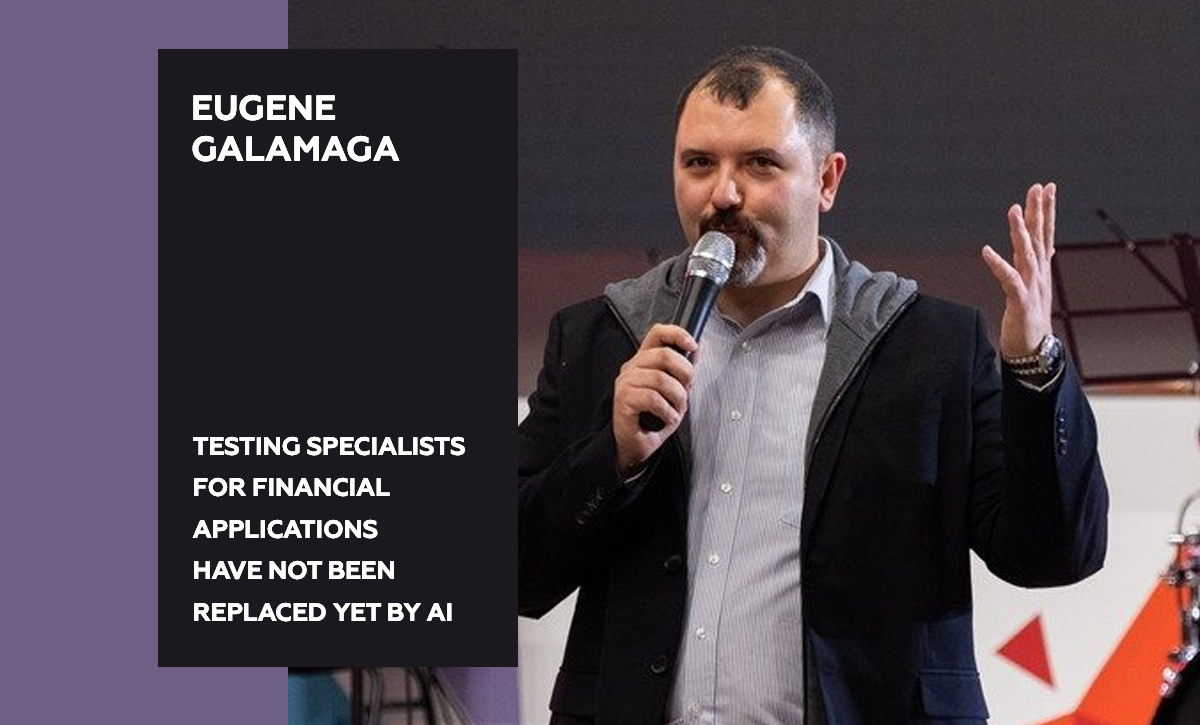

Interview with Eugene Galamaga, Head of the representative office of Allied Testing in Moldova. Be great together powered by Tekwill Section.
Eugene, thousands of employees have gone through Allied Testing over the past decade. Allied Testing spends much efforts to staff training, collaborates with the Technical and State Universities, so many students know about Allied Testing. But the company is not well known to the public. Let's make a small virtual business card for you. Allied Testing is…
Allied Testing is an IT company founded in 2000 in the U.S. Now the company has offices in Cyprus, Belarus, Serbia and Moldova. The company has more than 800 employees, including 330 in Moldova.
Allied provides services from development to business analytics, infrastructure support for financial analysts (and even tech writing in English and for the English (!)). But first of all, we position ourselves as a testing / QA company.
We have to compete with outsourcing monsters with tens, or even hundreds of thousands of employees, and in order to stand out among others, we have to specialize and occupy our narrow niche.
Testers check the software for errors, performance, stability, fault tolerance, security and many other factors that can be simply determined: whether you have quality software (QA - quality assurance - or quality control in our way).
Do you work with all business areas? Do they include software for both aviation and medicine?
The testing experience we have accumulated is enough to enter any new area of business or human life where you need to check the quality of software. But, if we talk about areas where good testing is especially in demand, these are areas where missed errors can be expensive,for example, medicine or finance. Our very first client was the largest American online broker, one of the leaders in the US stock market - Charles Schwab. And this set our specialization in the field of finance and trading products.
Moreover, you worked in the banking sector, and you definitely know such a financial news agency as Reuters. Allied has been working with them for more than 15 years, since then they managed to become Thomson Reuters, and have recently created the Refinitiv division. And we are still testing software for them.
A few days ago I interviewed a young girl working in IT. She's just a tester. And although her friends convinced her that it was a boring and monotonous job, she likes it. Moreover, she believes that for her future career in IT such a start is almost perfect. You’ve been representing Allied Testing in Moldova since 2005, from the very beginning. Boring and monotonous or interesting and exciting?
As in any work, there is a routine and a creative component in testing. There is such an offensive term “monkey testing” (they say there’s nothing smart to press buttons), but those who say that about testing don’t know how to test. It’s really not necessary to press buttons, but to realize which ones and how to press is sometimes a completely non-trivial task. To avoid loading you with financial terms, I’ll give an example. There is, BBC, which broadcasts on television in Britain, and we have a repeater in Moldova, which transmits BBC, but includes in it its programs, commercials, parts fall out because of problems with the signal, partscome with a delay. This is how there are two data streams that need to be compared. In our case, it was two text files of a couple of gigabytes with thousands of lines of exchange transactions. I had to fasten the algorithms for comparing DNA sequences, because there are similar difficulties (desynchronization, loss of sections from the sequence, etc.).
Well, it is important to have a holistic vision of the system so as not to miss anything. A few years ago, one of the leading “market makers” on the New York Stock Exchange rolled out a system for which, apparently, they did not conduct integration testing. One module called another, in which it activated a flag that puts the program in debug mode and randomly generates stock prices. In 45 minutes, the company lost $ 460 million (75% of its cost).
A plot for a Hollywood thriller…
Dynamically. But I have a question. Testing is still a routine, mechanical process. Automation is everywhere. Is there a risk that artificial intelligence will eliminate the need for human testing of software?
We ourselves are developers of automated testing solutions (the share of automation in our business now is 25-35%), and we ourselves make products using neural networks (though not directly for testing). And I don’t see prerequisites for the total replacement of man by machine.
Why?
As I’ve said, the most interesting and the most difficult thing is to figure out how to test. This is a creative task that is very difficult (if possible) to fit into the framework of machine learning. Let's just say - if the AI is brought to a condition where it starts writing code (by the way there is a similar start-up! but there is very limited functionality), it will probably be able to try to test it itself, but not earlier... Well, the AI itself also needs to be tested, by the way:)
Does anyone who started testing with “handles” in Allied Testing have a growth horizon?
You can grow in terms of management/coordination - becoming Tim Lead, QA Manager, Consultant, and in technical terms - developing programming skills and moving to automation of testing.
Many do not fully realize that automation of testing and development are very close tasks. In the West, the concept of SDET is common - Software Development Engineer in Testing, because during automation, in fact, we develop products that make tests for us.
I began to “collect” unusual hobbies of “IT people”. I’ve learnt from one of our mutual acquaintances, who is a fan of practical shooting, that you also shoot....
Not so much. After work, I want to devote time to my family, it is always not enough...
Well, I’ve not expanded the “collection”...
Don’t get upset. Write my hobby. A collection of ice wine and of those wines called late harvest. And as a collector I’m very lucky that I live in Moldova.
Why?
Germans and Canadians, legislators in ice wine are very conservative. Germans still make ice wine based on Riesling like in the past. Our winemakers are ready for experiments. And this is why I have ice wine from Cabernet Sauvignon or, even more exotically for my Western friends, from feteasca.
Then, in parting, I give a “secret” information. This year, Ion Luca makes late harvest from “viorica”. Don’t miss it….
 Life Principles


