




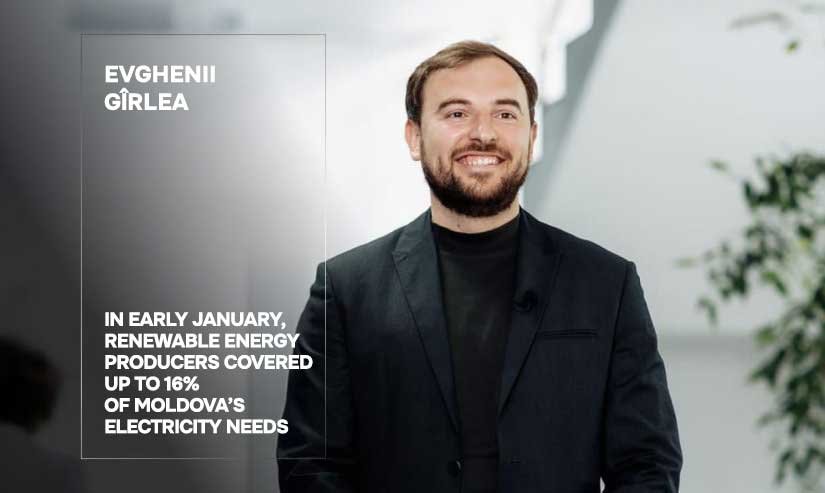

Interview with Evghenii Gîrlea, President of the Association of Wind and Solar Energy Producers in the Republic of Moldova.
Evghenii, good afternoon. In recent years, solar and wind energy have already been in the spotlight for many Moldovan entrepreneurs, as well as private consumers. But now the topic has truly become “hot.” I’ve already heard reports that during the current energy emergency, alternative energy is covering up to 10% of the electricity needs on the right bank of the Dniester.
To be precise, on different days in January that figure ranged from 7.8% to 16% of total consumption.
That’s a very significant share for Moldova, where alternative energy has only started to develop relatively recently. What is the current maximum generation capacity for solar and wind energy?
As for the Association I head up, it currently includes 36 companies with a combined generation capacity of 146 MW. Some of these companies also have affiliated legal entities that produce electricity, so the total capacity of “our” companies is already over 200 MW. Nationwide, if I’m not mistaken, the total installed capacity in alternative energy is around 520 MW.
Just for comparison, I’ll mention that the two combined heat and power plants (CHPs) in Chișinău and the one in Bălți produce 351 MW of electricity. But to be honest, I thought alternative energy hadn’t yet reached such impressive levels.
Over the past three years — and by the way, our Association was founded about three years ago — the production of alternative energy in Moldova has grown by 183%. So this sector of the national economy is growing at a very rapid pace.
Let’s talk a bit about the Association. Were there 36 companies from the beginning?
No, the initial group was smaller, around 10 companies. Electricity production wasn’t their main activity — they were transport companies, businesses from the agricultural sector. The reason for creating the Association was very simple. The pace of development in this field was outpacing the state’s ability to regulate what was happening. There was a need for an Association not so much to protect the interests of producers, but to enable coordinated work with government bodies. The energy sector isn’t as simple as it might seem at first glance. Besides production, it’s crucial to have mechanisms in place for selling electricity and forecasting generation volumes, since all power plants are connected to a single electricity grid, and managing that grid is a complex technical task.
The Association includes both solar and wind energy producers. Which direction in alternative energy is “winning” right now?
Until recently, the two were more or less neck and neck. But now, solar panels are starting to pull ahead — especially since two large solar power plants are scheduled to come online this year: one with 40 MW, the other with 60 MW.
At this rate, could Moldova reach 700 MW of renewable energy production this year?
That’s entirely possible. And it’s in line with the targets set by the Government for 2030 — namely, that electricity generated from renewable sources should make up no less than 30% of the country’s total energy mix. Given today’s numbers and the current growth rate in the sector, this goal is becoming more and more realistic. What’s more, the stress caused by the ongoing energy emergency has, in a way, actually helped the renewable sector. The government now sees us as full-fledged partners, and the situation is inevitably drawing in new players who’ve come to understand the potential and the necessity of renewable energy.
Speaking on behalf of those new “players,” I’d like to ask a couple more questions. You’ve pointed out that in the energy sector, beyond just generation, selling and forecasting are key. But that’s tough to do when you’re just building your first plant with a few megawatts of capacity.
That’s where it’s important to mention the specialization that’s already taken shape in the market. Right now in Moldova, two major aggregators have emerged that work with renewable energy producers. These are ML-Energy Group and Navitas Energy. ML-Energy Group aggregates 167 MW — and two-thirds of that comes from wind turbines. Navitas Energy has a portfolio of 113.5 MW, of which 73 MW are solar panels and 40.5 MW are wind turbines. It’s the aggregators who operate on the open market: they go to the energy exchange, handle market balancing, and manage electricity exports. Export prices are higher than domestic ones.
As I understand it, energy exports are banned during the state of emergency?
Not exactly. Electricity consumption is never constant — there are peak loads, which are very different from nighttime or holiday consumption. According to a resolution passed by the Emergency Situations Commission, starting January 1, 2025, from 6:00 AM to 11:00 PM, all electricity generated in the country must be reserved for the domestic market. Exporting electricity during that time is prohibited, except on weekends and public holidays. But what’s crucial — and I say this as President of the Association — is that we’ve found common ground with the state. The emergency situation hasn’t “killed” the growing renewable energy market. The government listened to us, and we’ve found win-win solutions.
What does the renewable energy sector need to accelerate its development? Investment?
Right now, investment isn’t a bottleneck — especially since banks are fairly willing to finance the creation of new production capacity. What’s more important is fixing the permitting system. If you look at a map of the country and try to find locations where new capacity can be brought online, almost the entire map is “red.” Permits have been issued for 1,800 MW. But not all of them are being acted on — permits are valid for two years and can be extended for another two.
We need a systematic approach to create an optimal mechanism for issuing connection permits — along with economic tools to prevent these permits from just sitting idle, waiting to be resold along with the land they’re tied to But that work is already underway.
What other trends are you seeing in your sector?
Electricity consumption is only going up globally. That means the need for renewable energy production will keep rising as well. I also see another direction that’s already gaining momentum around the world and is starting to take off in Moldova — energy storage. That’s absolutely essential for renewables, since solar and wind generation naturally fluctuate throughout the day. But I’m already seeing movement in this direction.
And as President of the Association of Wind and Solar Energy Producers, I want to take this opportunity to invite new players to join the Association. We already have a strong, established community of producers — joining us will make it easier for new players to integrate into the market.


 Life Principles


