




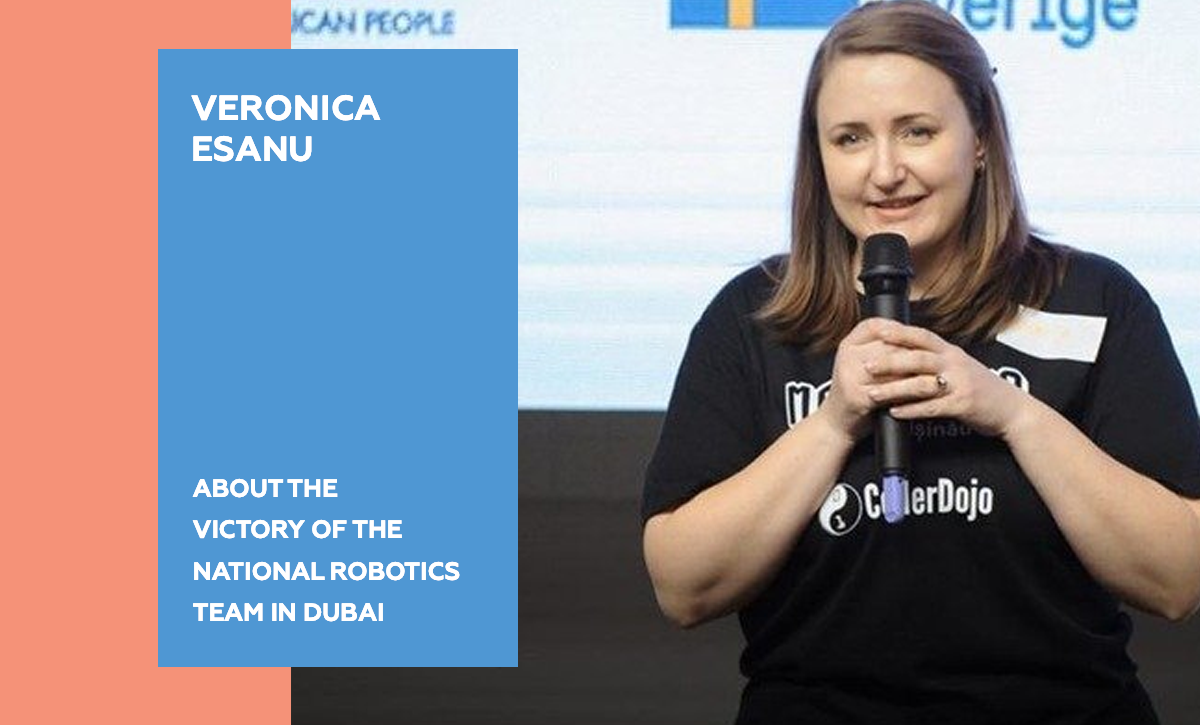

Interview with Veronica Esanu, ICT Education Program Coordinator, Be great together powered by Tekwill Section.
Veronica, when this interview comes out, the fact that the National Robotics Team of the Republic of Moldova won the international Olympiad FIRST Global Challenge in Dubai will not be news. You were there with our guys, it’s interesting to learn the details from the witness of the events…
Our team included six guys, 4 boys and 2 girls. This was the third Global Challenge. Unlike Cosmin Ciorba, Elena Graur and Dorina Levca, Andrei Copaci, Nicolai Mihalachi and Cristian Comendant were not newcomers.

Not so long ago I’ve written an interview with Cristian Comendant and he has told me about the concept of this particular competition and the rules of competitions. But tell me about them too, in a nutshell, tell you…
The FIRST Global Challenge 2019 decided to draw attention to the problem of global ocean pollution. By participating in this competition, children learn from their experience about the real problems of cleaning the water areas of the world's oceans.
The essence of the competitions is that each national team creates a robot able to collect balls of various types and to deliver them to the processing zone. The round lasts 2 minutes and 30 seconds. At the same time, to teach children to understand that global problems can be solved only with the joint efforts of all countries, the teams go through rounds in alliance with teams from other countries.

And how many teams (countries) were this year at Global Challenge?
189.
Yes, we must pay tribute to the organizers. The scope is really international. One could get lost among them... How was the path of our guys to victory?
The competition had nine qualifying rounds. In each round, two alliances were established, each alliance consisted of three randomly selected teams. Thus, our team played in an alliance with another 18 teams. In some rounds, we could co-work with an allied team, in other rounds with an opponent team. An individual score was maintained for each team in parallel.
During nine rounds our team managed to gain the highest score among the 189 teams participating in the competitions.
And who were the main opponents?
Our main opponents were the Romanian team and the Israeli team, they gained the first and second places throughout the competition. In the last two rounds we managed to gain high points, so we overtook them and came out on top. Israel was the second, and Romania the third.
As I understand, robots are team developments, aren’t they?
Yes, they are. For example, the robot created and programmed by our team was universal. He could collect both large and small balls. This made us a very valuable partner, we could complement the capacities of any robot in the alliance.
Already in the playoffs, according to the rules, it was possible to establish stable alliances. Besides us, the teams from Belarus, Norway and the team of Hope, refugees from Syria participated in it. One of them warmed the bench. Of all of them, the best robot was from Belarus, and the Norwegians and Syrians changed each other.
In addition to the competition itself, it was separately evaluated how each robot was built and programmed. We won here as well, and took the gold medal in the category of engineering innovation.

We definitely have something to be proud of! Did you have any time for the cultural program?
When we arrived, on 22 October, we managed to visit Burj Khalifa. We went up to the 125th floor. On the next to rise to level 125, and the next day, on 23 October, we made a trip around the city. We went to the sea. A common dinner one evening could not do without Arabic dances. The opening ceremony was particularly spectacular, as there were acrobats, a water show. The guys were really impressed.
And what was your status in the team?
In addition to the participants, each team also has two mentors. One is technical mentor, and the other is team coordinator. For several years, as ICT education program coordinator, I have been working on the logistics of our team participation in competitions. This year I already went with the team to Dubai. Two accompanying adults are an indispensable requirement of the organizers.
Thank you, Veronica, for the interview.
Pavel, it’s very important for me to mention everyone who supports the # Robotics program and our team. Such results would not have been possible without their support. These are the Ministry of Education, Culture and Research of the Republic of Moldova, USAID Moldova, the Embassy of Sweden in Chisinau, the United Kingdom in Moldova - the Embassy of the United Kingdom in Chisinau and the ATIC.
Due to this program, implemented in Moldova since 2014, more than 15,000 students from all over the country enjoyed the opportunity to better understand technologies and acquire important skills for their future.

 Life Principles


