




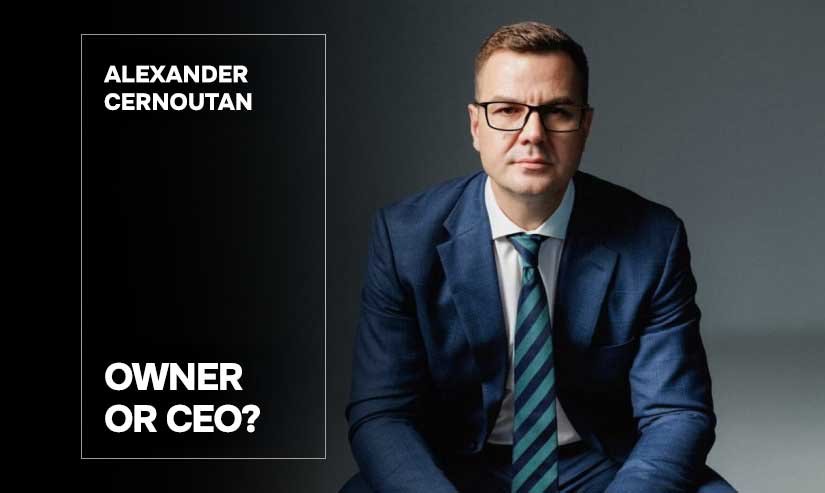

An interview with Alexander Cernoutan, owner and CEO of Rikipal.
Alexander, good afternoon. Mind if I start with a question that’s been on my mind?
Over the past few months, five different entrepreneurs have asked me if I could help them sell their businesses. And we’re not talking about struggling companies—they’re profitable enterprises. It’s just that people’s plans change, new interests come up. But in Moldova, there’s no dedicated platform for selling a business. You can’t just post it on 999. Do you think there’s a need for such a platform?
I’m sure there is.
Take you, for example... Would you be willing to sell your business if you came across a new and exciting project?
At Rikipal, things are set up in a way that I wouldn’t have to sell the company even if I decided to pursue something new. The team is well-established, solid, and knows exactly what to do and how to do it.
So, if I saw a new niche or got an interesting offer with equity in a business, I’d definitely give it a shot.
But I think you’re wrong to link selling a business with launching a new project. A properly run business should always be ready for sale, and a smart entrepreneur should always be ready to sell if the right offer comes along.
That’s exactly the part I’ve always struggled to wrap my head around.
To this day, I can’t forgive myself for turning down several solid offers to sell allmoldova—my media project back in 2007–2008. The price was great, but I just couldn’t picture life without my business. Turns out, that was a huge mistake.
Maybe the reason is that you’ve always played both roles—owner and CEO—and couldn’t separate the two.
Would you be able to?
Well, you know my story. I was a hired manager at Rikipal. Then I bought the company from the owners, the one I was running. That’s how I became both the CEO and the owner.
And would you be able to go back to being just a hired manager?
Let me think... No, I couldn’t go back to a “pure” employment role. I’ve developed a mindset that goes beyond just handling tactical tasks as a director while the owners deal with strategy. I’m used to shaping the company’s strategic direction too. But I can definitely see myself as a CEO with a minority stake. Depends on the size of the project.
And the industry? It’s not that easy to jump into managing a business in a whole new field.
It’s not easy, but it’s absolutely doable. When I came to Rikipal, I had no idea what pallets were or how the business worked. Now we’re market leaders, and I paid back the owners’ investment within the first two or three years of running the company. So you can learn any business if you approach it the right way. Before Rikipal, I ran a company that made PVC windows and doors. I even had some experience working with metal and rolled steel. So the issue isn’t the niche—it’s the system and how you approach it.
Right, I remember you studied systems thinking with Vyacheslav Kunev... By the way, how useful has that been in your current business? Everything at Rikipal seems to run like clockwork—you seemed pretty system-oriented even before.
I think every entrepreneur who wants to keep growing should take a course on systems thinking. For example, after that course, I seriously started working on integrating artificial intelligence into our processes.
In the pallet business?
In business development. For example, in April last year, we got a request from a Romanian client with a very specific need. He required custom pallets for transporting windows. I won’t bore you with the technical side of it, but it’s a completely different kind of product. We took on the project, and although his production cycle lasted less than six months, by the end of 2024 he ranked sixth among our clients in terms of annual profit contribution.
And how does that tie into artificial intelligence?
We developed three AI-powered chatbots. One scans the Romanian market to identify potential clients who might need pallets. The second prepares customized commercial offers—it researches publicly available information about each potential client and tailors the offer accordingly. The third automates the entire outreach process.
We’re jumping around a bit here, so I haven’t even asked you the main question I wanted to talk to you about. Pallets are a very accurate indicator of Moldova’s economic condition: when exports go up, pallet demand rises; when exports drop, so does pallet demand. And this is exactly what I wanted to ask you...
Rikipal as an indicator of Moldova’s economy?
Why not? You’re the market leader, and you’ve got fifteen years of experience in the industry, along with a strong grasp of the numbers. I’m not wrong about the 15 years, am I?
Almost. It’ll be 15 years in May.
I’ll make a note of that—gives me a reason to congratulate you. But back to the numbers—especially since Rikipal operates 100% above board, so you’re not hiding anything…
I’m not hiding anything. Based on our numbers, Moldova’s economy has been pretty stable over the past two years. A few years ago, our annual turnover was 4 million euros, excluding VAT. These past couple of years, it’s been around 3 million, with about the same volume—roughly 300,000 pallets per year.
Do you import all the wood for your production?
No. You might not know this, but my academic background is in environmental economics—I studied at the Academy of Economic Studies in Bucharest. That’s why I’ve been working for years to make Rikipal part of the circular economy.
Circular?
A closed-loop economy. Out of the 300,000 pallets we sell annually, 150,000 are used pallets that we refurbish and put back into circulation. That means we’re saving around 15–20 hectares of Moldovan forest from being cut down every year. Over 15 years, that adds up to 200–300 hectares. Even our production waste gets sold as firewood, which also helps reduce logging.
But back to your original question—if we’re talking about Rikipal as a reflection of Moldova’s export situation—right now, we can’t brag about growth, but we’re not seeing any major decline either.
The year’s just beginning. What are your plans—and Rikipal’s—for 2025?
We’re going to develop our Romanian operations. When it comes to standard pallets, we’re not competitive in Romania—they have their own forests and manufacturing. But in niche, non-standard products, we can compete. That’s Rikipal’s focus. As for me, I’ve decided to mark my 15-year milestone by systematically searching for new niches and projects. Like I said earlier, a real entrepreneur should structure their business so that it can either be sold at any moment or run with minimal involvement from the owner. Right now, I feel free to explore. What matters most to me is growth and discovering something new. That’s the principle I live by.

 Life Principles


