




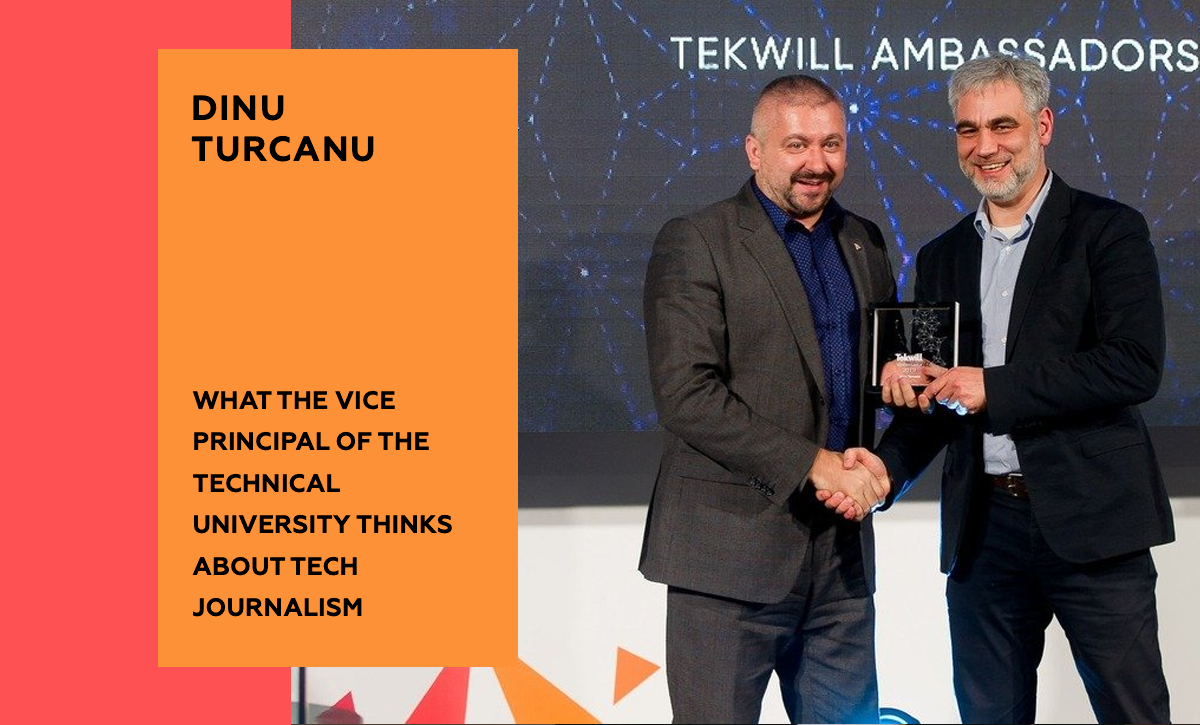

Interview with Dinu Turcanu, Vice Principal of the Technical University of Moldova in charge of Informatization, Partnerships, Institutional Image and Communication. Be great together powered by Tekwill Section.
Hi, Dinu. Actually, under the guise of an interview, I wanted to meet you to test one business model. But it will be tactless to begin immediately with it. It’s my pain to look for a new business for myself. Let's begin by treating your pains. Without thinking, what hurts you the most?
Give me 50 Python programmers.
This sentence reminds me of Freudian slips. Explanation is needed.
This is the pain of many years of controversy, which, perhaps, has hardly begun to change for the better now. Our IT companies are still living from day to day. Most often, they don’t need engineers in the true sense of the word, but quick workers. A new customer came, X programmers in Y language are needed urgently. Thinking? Nonsense! Today you need Python and fast.
I ask: “And what will happen in two years, when, suddenly, Python will no longer be needed?”. The answer: “There is YouTube, they will learn another programming language there”...
What do you want to teach (at the Technical University)?
Thinking. Making own products, and not going from one outsourcing task to another, architects are needed. I mean IT architects. When a specialist has systematic and creative thinking, a programmer will grow from him better, but the main thing is another one, he can create, rather than execute.
Is everything so bad? There are definitely not enough programmers on the market, all companies complain about this...
I’m glad that cooperation with companies has changed for the better. I don’t mean helping the University with money. More importantly is that companies began to cooperate with us by having their specialists involved in the training process. In general, if we talk about the quality of teaching, then we have something to brag about. For example, this year, IT classes and various training courses were introduced at our University that are thought and conducted by more than 10 teachers and trainers from France, Romania, Germany, etc. And, you know, they are delighted with our students. Moreover, I can’t stop boasting about the whole University; things in other departments are the same. Architecture is taught by the Vice-Principal of the Romanian University of Architecture and Urbanism, Ion Mincu - Tiberio Florescu, as he considers that he hasn’t seen such a level of projects as some of our students showed him in Bucharest.
All. We’ve talked a little about your pains and joys. Let’s go smoothly to my question. But first, an interim question. Does Moldova have IT journalism? In the sense of journalists and the media covering IT. And is it needed in general?
Both no and yes.
That is, “no and yes”?
There is no such journalism. Let’s consider winemaking, for example. There are journalists who have been working on this issue for years, there are many bloggers who write about wine. As regards IT, there is emptiness, although, according to statistics, the revenue of the IT sector began to outrace winemaking.
As for “yes, it is needed”. I can say a lot of things about this. IT-journalism is needed for career orientation. Although the Technical University, in my opinion, is the only institution of higher education in Moldova who has noted the growth of students in the last two years, but they are still not enough to meet all the needs of IT companies. And if young people hear more about IT education in Moldova at lyceum, this will increase the chance for them to continue to study with us.
Moreover. Whoever has visited the University from among foreign guests, and there are many of them, they ask why there is so little information in English about the University, the students and their work. Unfortunately, we are absolutely “opaque” for foreigners. The emergency of IT journalists is not able to solve this issue. Neither Russian, nor Romanian is known to Germans or Americans.
Dinu, in journalism this is called a “piano in bushes”. You brought the conversation to the issue that is interesting for me. I’ve been away from business for a year already on a journalistic sabbatical, and, frankly, I already miss some new project. But I don’t want to rush with the choice, as I want to test hypotheses. And one of them is IT media in English. And only in English. Because its purpose is curing the “pain” of IT companies, which I see at every step. The pain is called: “How to enter the international market”. The international market has only one language - English.
How can I help?
Criticism of the idea or its components and for what everyone comes to you. Staff. If I decide to put in place such a project, then I’ll need those for whom there is already a name in English, tech writers. We don’t have a single one in Moldova, they’ll have to be prepared. And it is easier to prepare them from among the students of the Technical University than from among the students from the Faculty of Journalism. Here we need special knowledge or, rather, the ability to acquire it. Plus, of course, journalism skills. But it’s easier to teach...
At first glance, it’s a good idea. The segment is empty, I’m sure that if there are specialists who write well in English, then you’ll simply sell them as copywriters to the Moldovan, Ukrainian and Russian markets. Do you want me to propose another option?
Which one?
If you don’t cool down with this idea, let's gather students at the University after the New Year, you'll speak to them, even if they criticize your idea. In the end, your media will be focused on them as an audience and as potential journalists. Are you ready?
I’ll answer after the New Year, but thanks for the offer.
More information in the end. We are currently conducting an IT business master degree programme for non-IT people - journalists, banking specialists. We teach not so much programming languages as understanding the field, in other words, we all have to work with big data, and in any field of business their understanding will enhance competitive opportunities. So, you can look for like-minded people among the students of this master degree programme.
Thank you Dinu. You’ve given a couple of ideas and served me with coffee. This is the most successful visit to the office of vice principal in my life. Last time I was in a similar office when the management wanted to expel me from the University for two fails in a examination period. Whatever you say, life is always changing for the better. As I wasn’t offered a cup of coffee that time.

 Life Principles


