




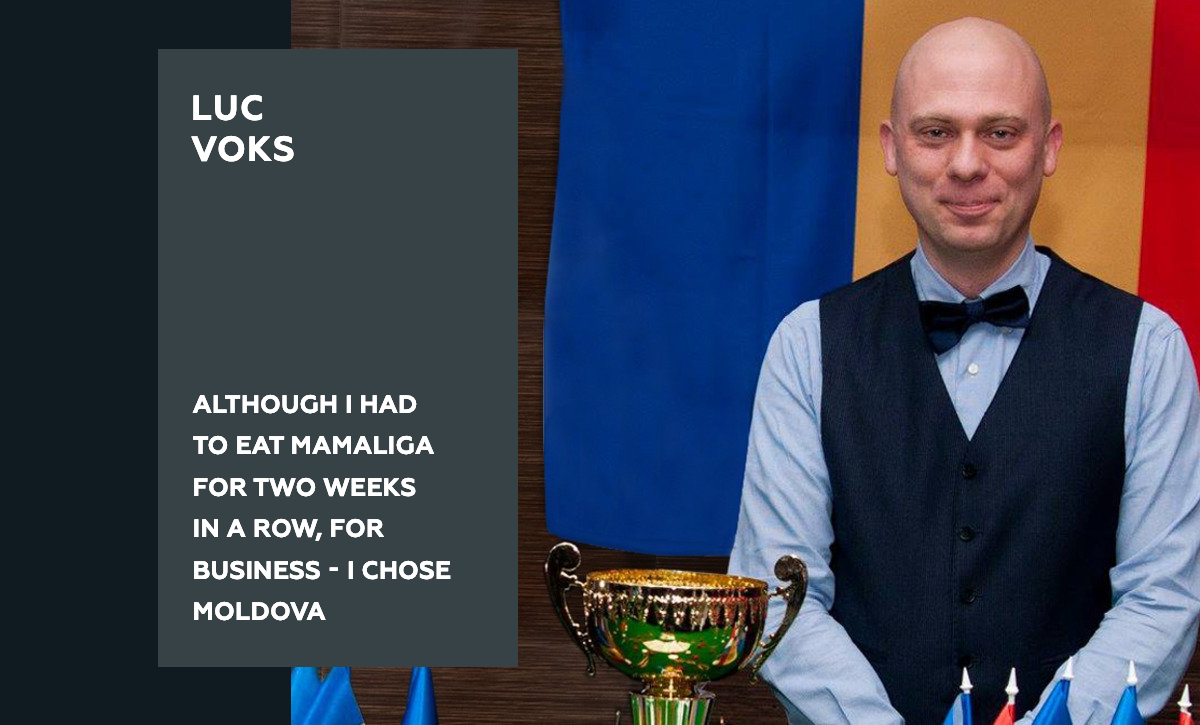

Interview with Luc Vocks, Director at Development Aid. Be great together powered by Tekwill Section.
One of the founders of the science fiction genre was Jules Verne. He wrote soundly. If you pick up one of his best books, “The Mysterious Island”, it’s easy to notice that each chapter begins with a short summary. Here is, by the way, how the first chapter begins:
“The hurricane of 1865. - Screams in the air. - A tornado blows away a balloon. - The shell bursts. – Water around. - Five passengers. - What happens in the basket. - Earth on the horizon. –Payoff”.
In some ways, the interview with Luc was also unrealistic. What he has done since 2007 in Moldova can be called fiction. So, the introduction to the interview may be as follows:
“The Dutch political scientist in St. Pete. - Political tourism in Moldova. - Two weeks on mamaliga. – The last 5,000 from parents. - Bounty hunting. - Return to Moldova. - How 180 Moldovans under the Dutch leadership created a world leader. - To be continued”.
And now the dialogue. By the way, in Russian. Because, in addition to Dutch and English, Luc speaks excellently Russian and well Romanian. A conversation in the office of Luc, located opposite the Memorial of Military Glory, in the office dining room, which looks like a pub for which it was quite possible to earn some money. A bartender with tattoo makes coffee, and Luc and I sit down to talk.
Luс, to get in good with a foreigner, you need to ask him a non-trivial question, a question of metaphysical depth. So. How do you like Chisinau?
Avery big city.
It seems that after a dozen years of life here you might not have been ironic...
I’m not ironic. I grew up in the town of Venlo in the south-eastern Netherlands. My town has not more than 100 thousand inhabitants, and in Chisinau, although not one person in the world knows how many people live here exactly, but they are exactly six to eight times more than in the place where I was born.
I think every new acquaintance asks you this question. I’ll not be original. How has the Dutchman got into Chisinau?
A short or a long version?
Closer to the long one
In the Netherlands I studied business administration. This was my first master’s degree. But it was somehow boring, and I wanted a radical change. Studying once again in the Netherlands would not be something fundamentally new, but going to study in Russia in 2002 was an adventure. I found a small university in St. Pete, with teaching in English, and went to a country where bears walk in the streets.
You definitely learned Russian.
Learning was interesting. International students, excellent teachers. We learnt political science related to Russia. Former Soviet political system... What could be more exciting for a Western political scientist? This is how I‘ve got the second master’s degree (Russian Studies), already as a political scientist.
And then you learnt IT?
And who told you that I’m an IT specialist? I’m a political scientist who runs an IT company.
I’m arming myself with patience and looking forward to continuing the story of how a Dutch political scientist, after studying in St. Pete, creates an IT company in Moldova. By the way, how many people do you currently manage in Chisinau?
180.
Go on with your story…
After St. Pete, I studied in Hamburg, Peace and Security Studies. This, by the way, was my third master's degree. When I lived in St. Pete, I met a girl from Moscow. I went to her, lived in Moscow, opened a small company, but everything was somehow going wrong. In everything. It was also cold that winter in Moscow. Minus thirty. And then one Dutch political party held a seminar in Chisinau. Considering my Russian language and basic specialty, I was proposed to participate in this seminar. I looked at the weather forecast, compared -30 in Moscow and -5 in Chisinau and decided to go south.
And what is your first impression about Moldova?
It was February 2005. For two weeks, for some reason, we were fed mamaliga twice a day. The first day I really liked it. Now I never eat mamaliga again.
Even polenta in Italy?
I tell you, two weeks in a row, twice a day.
And yet, you fell in love with Moldova and decided to leave everything in Moscow and move here?
You are rushing things. I returned to Moscow, but both my business and my personal life did not work out. In March, by the way, I went again to Chisinau with the same party and spent another two weeks on a mamaliga diet. Have I told you that I can’t see mamaliga?
Yes, you have...
As a result, I returned to the Netherlands, settled with my parents and began to think what to do next. I decided to try to do business again. I had two ideas. The first was a global IT company. But it needed a lot of money, and I decided to start with the second idea, to earn and reinvest income in the first one.
I started with a recruiting company dealing with staff recruitment for international donors. For example, you need a doctor with 10 years of practice, ready to move to work in Congo. Something like that. Or a specialist in the higher education system in post-Soviet countries with at least 5 years of experience in European institutions.
This is a good activity, as a website and a telephone are enough to start. I started in April 2006. I found the first couple of customers in July. Then silence for a few months. My parents already began to look askance at me, why did we invest in your education? For you to live in our house and earn nothing?
And you were 26 years old?
Exactly. And I didn’t want to give up. To increase the chances, I needed to buy good databases. I borrowed another $ 5,000 from my parents. However, their comment was unequivocal. This is the last money that I can count on in my education, as they have already seriously invested and it was the time for me to start living on my own. In Russian they say “валитьиздому”. It was December.
The investment in the database worked. Already in January, I could return all 5,000 to my parents. In February, the revenue was higher, in March - even more. And I realized that I can move on to the plan of creating a global IT company.
And what was its idea?
Collecting and selling information on everything related to international donors and tenders. EBRD, USAID, IMF, tenders, grants, specialists, winners of past tenders... Together, this is a huge amount of information that thousands of people and companies need. And since there is an array of information and demand for it, then the one who organizes the most convenient access to it will earn money.

The idea is clear. Were there no serious competitors?
There were. Already two dominant players in the world. We started late, but in the end, we nevertheless won.
One of the most important tasks was to optimize the expenses of the future company. A large amount of manual information work was to be done. With salaries in the Netherlands (Germany or Belgium) this would be unprofitable. And I needed programmers, sellers and employees to create databases. Then I decided that the Netherlands are a beautiful country, but my future is not there.
And you remembered the country with mamaliga and warm winter?
I considered several countries, but Moldova still seemed to me a country of unlimited possibilities for me. Firstly, except for mamaliga, which I could not look at, besides zeama, which I still like. Secondly, the salaries in 2007 in Moldova were at such a level that they quite fitted into my business plans. And, besides, I had already lived in Moldova for four weeks and, unlike, for example, Romania, I could speak Russian here, which I knew quite well.
You speak Romanian as well...
I already learned it here…
So…
So, in 2007 I opened a company with foreign investments in Moldova. To my surprise, I myself was a foreign investor. For a long time, recruiting brought more revenuesthan information services in the field of grants and international donors. But, somewhere from 2010-2011, the situation has changed, and now Development Aid is a world leader in this field.
No more competitors?
There are strong companies in Belgium and the U.S., but the amount of information with which they work and the number of customers they have is much smaller.
And how many regular customers does Development Aid have now?
More than 1500.
Luc, looking at of the duration of our conversation, I already understand that the interview will have four pages, and I haven’t asked half the questions that interest me. Do you mind if we hold the second in the coming months?
I don’t…
 Life Principles


