




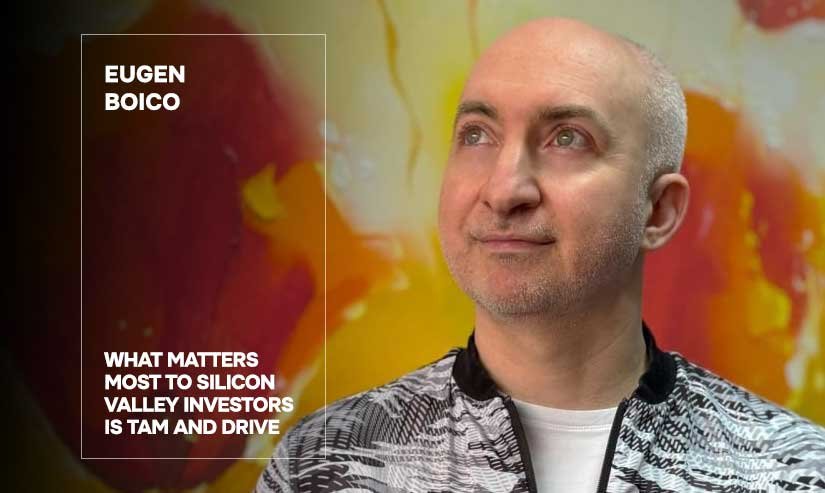

Interview with Eugen Boico, CEO of Publicis Moldova. Topic: studying at Future London Academy and impressions from his trip to Silicon Valley.
Eugen, hi. I’d like to talk about your trip to Silicon Valley for your studies—especially since Moldovan businesspeople and startup founders don’t go there all that often yet. First question: how did you end up there?
I’m currently studying at Future London Academy. It’s a program for leaders in the design field. And it’s not just about graphic design—there are no strict boundaries at this school. Starting a company can also be seen as designing a company. So the program is really about creating and scaling.
Who else is in the program with you?
Leaders of big and not-so-big companies, teams, and communities. Also, interestingly, public servants from leading countries around the world. The goal of Future London Academy is to give leaders the most up-to-date knowledge and prepare them for what’s next.
And you visited Silicon Valley as part of the program?
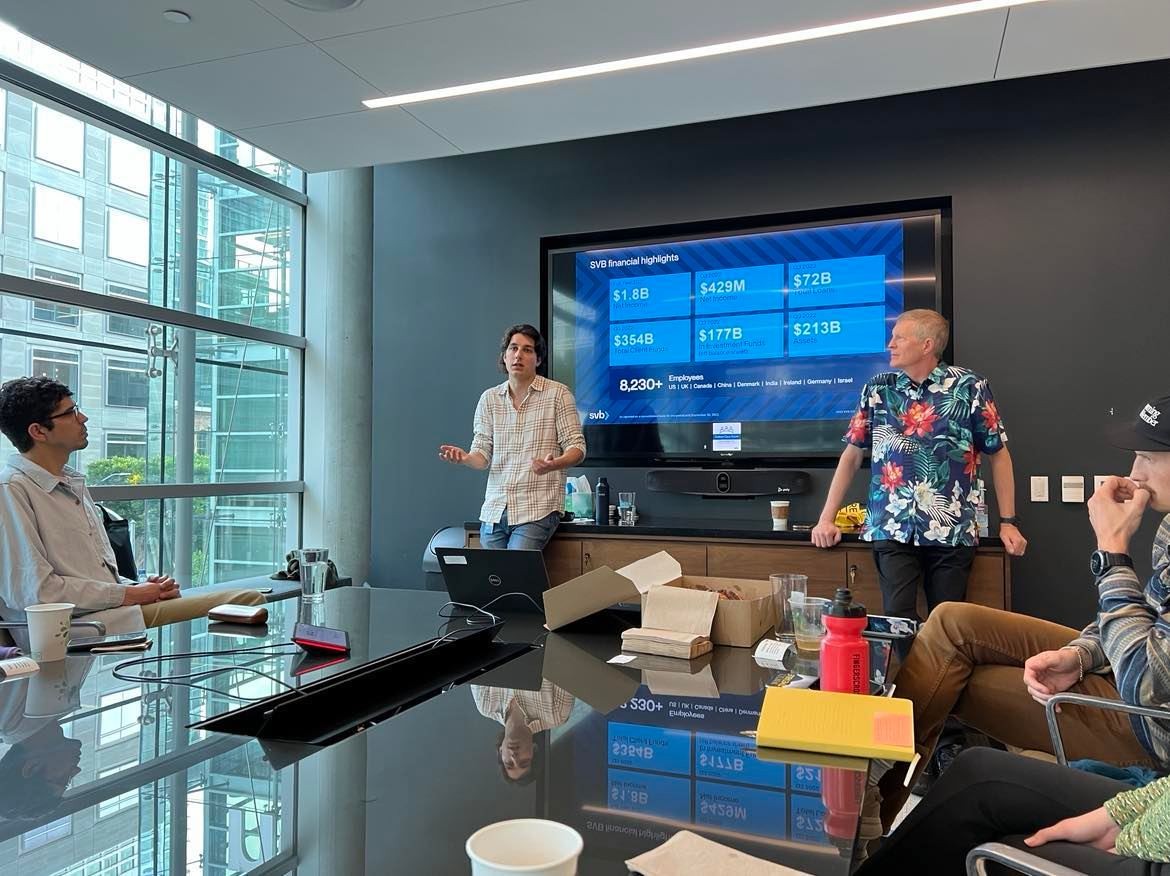
Yes. It was a 10-day intensive in San Francisco where we met with all kinds of instructors. Mostly practitioners—because in the U.S., it’s normal for people who’ve accomplished something to teach. No one’s surprised when a successful venture capitalist ends up teaching at Stanford. He actually made the strongest impression on me. But besides him, we also had sessions with startup founders, serial entrepreneurs, and executives from financial institutions like Silicon Valley Bank, which currently manages $200 billion in assets.
Was this your first time in Silicon Valley?
I’d been to the U.S. before, but it was my first time in San Francisco and Silicon Valley. The trip started off on an emotional note. Local news was blasting warnings about hail and rainstorms in the San Francisco area—storms the likes of which hadn’t been seen in over 100 years. It all sounded like the end of the world. But when I landed, San Francisco looked like Amsterdam on a sunny day. Sure, some parts of the state were hit hard by mudslides, but I didn’t see any damage in the city itself. It was just a place where it rains now and then. And that turned out to be my first lesson of the trip.
How would you sum up that first lesson?
The first lesson is: be careful with how modern media in developed countries presents things. They often blow events way out of proportion—especially in the U.S.
If that was the first lesson, I’m guessing there are more?
I’ll try to break down my impressions. Lesson two: investors are really only interested in two things—founder drive and TAM.
TAM?
Total Addressable Market. The maximum size of the market your product is targeting. That was surprising to me. We’re used to evaluating a business by its product, user experience, and team. But in the Valley, investors spend more time making sure you’ve calculated your TAM correctly, that the market is truly as big as the founder claims. It’s like a litmus test. A founder might know their product inside and out, but if they haven’t figured out the full potential market size, it means they don’t fully understand their own business. And the other key factor is founder drive. So yeah, once again: it’s all about TAM and drive.
You know what, I think I’m going to make a note about TAM. I’ve always started by inventing a product that I thought people needed—and only then figured out who it was for. Alright, let’s keep going. Third lesson?
Third lesson? The market is going through a kind of sobering up. For years, investors were throwing money at startups. If a founder used the right buzzwords and made big promises, that was enough. Investors would go with the logic: we’ll fund 100 startups, one will take off—that’s good enough. That model doesn’t really work anymore. Things are shifting.
Fourth?
Fourth lesson: Silicon Valley and San Francisco today are a strange mix of extreme cynicism and a proclaimed pursuit of human values.
Cynicism?
Cynicism in the sense that everything has a price tag, everything is measured in ROI, and if it’s not—then it’s not worth your attention. At the same time, all of our mentors, almost in unison, kept coming back to core human values. But I couldn’t shake the feeling that they were mostly just putting on a show—pretending, in the classic fake it till you make it way—that there’s kindness and humanity at the heart of their businesses. Like they wanted to say: “All these seemingly cynical transactions—buying and selling companies, scaling products into multi-unicorns worth tens of billions, hiring and firing thousands of employees—it’s all really driven by a human face and a higher purpose.”
You know, maybe our entrepreneurs don’t yet have that same instinct for raising billions of dollars. But we also have a lot less of that cynicism. And I’m not saying I know which is better. Personally, I’m on the side of humanity. Which brings me to the fifth—and maybe most important—lesson.
?
Just because you can doesn’t mean you should. Just because you can design a pitch deck, come up with a product idea, and raise $15 million for it tomorrow — doesn’t mean you should. That’s what the Stanford professor I liked the most was talking about. He spent 15 years working in Europe, at Siemens, in a C-level role — Chief Innovation Officer. Every weekend, he flew from Germany back home to the U.S., and then returned again. I could barely adapt to the time zone during those 10 days, struggling not to wake up at 4 a.m., and it took me another month back in Chișinău to fully adjust. He lived in a state of jet lag for 15 years.
Now he says that just because you can, doesn’t mean you should. That introspection is just as important as chasing success or big money. That figuring out who you are, what truly belongs to you — is just as important as scaling and reaching volume. You can see this distortion clearly in the headlines of San Francisco’s business media: “Raised $1 million,” “Raised $10 million,” “Raised $50 million.” The goals are clearly shifting.
It’s no wonder — in the Bay Area, as they call it, even in a downturn, there’s a trillion dollars available for investment. In normal times, it's two or three trillion. That kind of money fuels a lot of cynical, purely transactional ideas — where the focus is less on improving lives and more on multiplying capital.
I’m not going to get all philosophical and say everything needs balance — I haven’t raised a million in funding yet, and I don’t have that personal experience. But I recently had a conversation with someone who earns really well but has been living in a state of constant stress for years. You know what he said was his most valuable part of the day. “I don’t work for the first two hours in the morning. I make breakfast, read a book, look out the window — and those are the best two hours of my day.” Okay, let’s talk about the everyday stuff. You didn’t just study while you were there…
The pace of San Francisco is all-out hustle for money — no exaggeration. For fun (and since I was waking up at 4 a.m. anyway), I decided to find a nearby gym and get in a workout. I signed up for the first slot at 6 a.m. The gym was tiny. Twenty treadmills and twenty benches packed in tight — rent must be insanely high. Club music is blasting, and the trainer is already going full throttle with 40 people at 6 in the morning. Twenty hit the treadmills, twenty hit the benches. They rotate in 10-minute intervals — 10 minutes running, 10 minutes lifting.
One day I slept in a little. I went to the 8 a.m. session instead — it was a Saturday, I wanted to catch up on sleep. And I was shocked. At 6 a.m., the place was packed. At 8 — half empty. And the reason is obvious: it’s a Terminator culture. Most CEOs talk about waking up at 4 a.m. for personal productivity. By 6 a.m., the city is already buzzing. Young, driven people are sprinting toward success — and everyone else is doing their best to keep up.
At the same time, one of my classmates told me he hates this city. Hates that, for all its wealth, it’s so indifferent to its own people. There are so many who’ve been left behind, just tossed onto the streets. So many struggling with substance abuse — fentanyl especially. It’s essentially an epidemic.
There are entire neighborhoods in San Francisco where tourists are strongly advised not to stay. One of my classmates from Canada had his wife robbed at knifepoint in one of those areas. Two other girls from our course had their car broken into while they were in a restaurant — everything valuable was stolen in just 10 minutes. But then, just an hour later, a guy called them, said he’d found their bags and documents, and helped return them.
The contrast there is extreme. Pure black and spotless white coexist side by side at every step.
You’re clearly impacted. But let me wrap this up. I don’t think it’s cynical — I think it matters for any kind of business. I liked your “lesson two.” You need drive, and — to rephrase — you must go after a market that’s big enough. I’m definitely writing that one down

 Life Principles


