




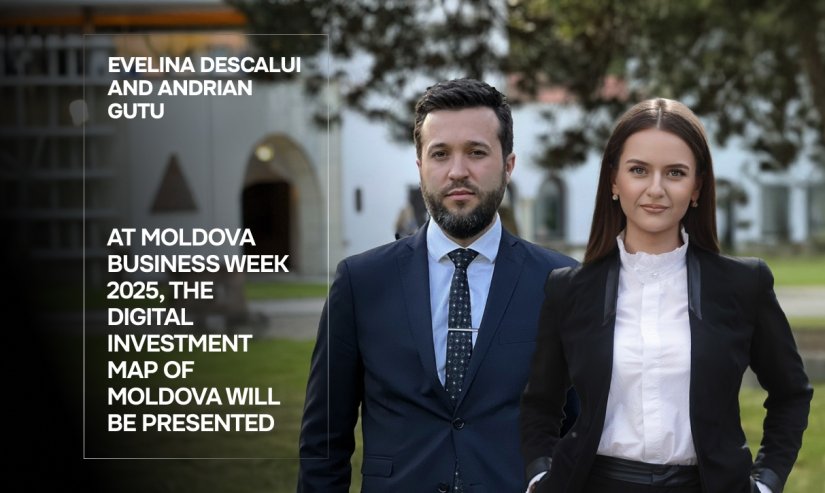

Interview with Evelina Descalui, Head of the Investment and Investment Protection Department, and Andrian Guțu, Head of the Post-Investment Support Department at Invest Moldova.
From September 15 to 19, “Moldova Business Week 2025” will take place – the country’s main economic forum, held under the slogan “Moldova is Open for Business.”
This year, the event will showcase Moldova’s steps toward sustainable industrial growth, based on the National Industrial Development Program – the first initiative of its kind to introduce government support for industrial investments, aimed at attracting and expanding opportunities for both local and international investors.
One of the forum’s key highlights will be the presentation of the Investment Map of Moldova – a new digital project by Invest Moldova.
Evelina Descalui and Andrian Guțu shared more details about the stages of creating the Investment Map and its prospects for development.
Evelina, Andrian, good afternoon. Thank you for giving me the opportunity to preview the Investment Map of Moldova in “closed” mode before our meeting — a tool that Invest Moldova prepared for Moldova Business Week. Where did the idea come from? To me, it feels very timely and, most importantly, extremely practical and useful for potential investors.
When talking about the origins of the project, it’s important to note: the idea of the map didn’t appear “on paper” but came from real business demands. During our visits to investors in different regions of the country, they asked us for specific data — some were interested in demographics in certain districts, others in available resources and infrastructure. That’s when we realized investors needed more detailed, district-level information that would be convenient and visually accessible.
This is how the concept of the Investment Map was born — a tool where the most relevant information for investors is collected for each district, including available investment profiles. While analyzing how best to implement it, we looked at the experience of Invest Ukraine. Our colleagues were very open and shared how their map works in practice. Their experience confirmed that we were on the right track and helped us shape the approach for Moldova.
So, the focus is also on the regions?
It is very important to attract investors not only to the established hotspots for investment, but to all territorial units of Moldova. The map helps here too: it shows that investment potential exists not only in Chișinău, but also in other districts of the country.
At the moment, the map has a limited number of objects. How will the process be regulated? For example, if I am a business owner and want to attract investment — can I place my project on the map?
We made the process as simple as possible, but projects will still be selected. An investment proposal must meet criteria such as having a significant economic impact, creating jobs, and being of interest to the region.
Moreover, you asked the question from the perspective of a private company, but we are primarily focused on ensuring that state-owned assets currently standing idle are included on the Investment Map: factories, hotels, buildings. We will collaborate with local authorities and the Public Property Agency to ensure such assets are added to the catalog. A good example would be the glass factory or the Zarea Hotel — information about these investment opportunities will also be available through the Investment Map.
So, the map is not only about new projects, but also about reviving old assets?
Exactly. We thought about those assets that need a new life. For example, old manor houses, abandoned hotels, or former hospitals. These buildings can serve as the foundation for projects in the HoReCa and tourism sectors. Filters have already been built into the map: an investor can search for objects by sectors (tourism, industry, IT, energy), by regions, or by types of assets.
Can objects be searched both by districts and by sectors?
Yes, that’s exactly how the map is structured. An investor can select a specific district, such as Orhei or Cahul, and see what investment profiles exist there. Or they can search by strategic sectors: from agri-food and automotive to energy, IT, and tourism.
For example, in the Agrifood section one can find projects in agricultural processing, in Automotive — proposals for assembly plant sites, in Tourism — buildings and land for developing HoReCa, and in Energy — facilities related to green energy. This gives investors flexibility: they can explore both geographically and by industry.
Have you considered ways to promote the map?
Yes, we see the map as a daily tool in our work. Every day we meet with foreign companies. We show them presentations about Moldova: what is exported, what incentives and taxes exist, how sectors are developing. Now, the map will become another section — after the meeting, the investor will be able to log in and see which projects are of interest. We also plan to involve Moldovan embassies in promoting the map; for example, a small poster with a QR code leading to the map could easily be placed in a waiting area.
I noticed that the map also includes demographic information by regions. Why would that be useful to an investor?
Because for many it is important to see the context. When you click on a region, you can access information about the population, tourist attractions, and major companies. This helps build a more complete picture: the investor understands who will work at the enterprise, what consumer market exists, and what makes the region unique.
In your opinion, are local specialists prepared to represent Invest Moldova’s investment profiles, including those to be listed on the map?
Training is already underway and will continue. Together with a number of public organizations, we are conducting workshops and courses for municipal employees so they can learn how to present their assets in the right format. So, there is a lot of joint work ahead. We see the map as a place where everyone connects: government agencies, municipalities, real estate agencies, the private sector, and investors.
Will the map continue to develop? Or is it already a completed project?
The map will always be in development: regions add new data, new assets appear, statistics are updated. We invite everyone to send us information, photos, descriptions. We cannot know every detail of all 32 regions of the country, but together we can make the map as complete as possible.
Will the diaspora also be involved in promoting it?
Yes, the diaspora is our most important voice abroad. We are already cooperating with embassies and consulates. Recently, the “Diaspora Congress” took place with the participation of President Maia Sandu. Such dialogues show that the interest is there.
What other opportunities does the map offer investors?
It saves the most important thing — time. Everything is collected in one place: investment profiles, land plots, buildings, enterprises, regional statistics. It provides quick and transparent access to information. For the investor, it is like a guide to Moldova. For the state, it is a way to show that we are digitizing processes and becoming truly investor-friendly.
So, can we say that the map will become an important tool in Invest Moldova’s work?
Yes. It works on several levels. First, as a tool for attracting investments. Second, as support for the regions. Third, as a showcase for citizens and the diaspora to better understand the country’s potential.
And most importantly — it is a living tool. It will be constantly updated, developed, expanded. We are confident that the map will be an important step toward making investors choose Moldova.

 Life Principles


