




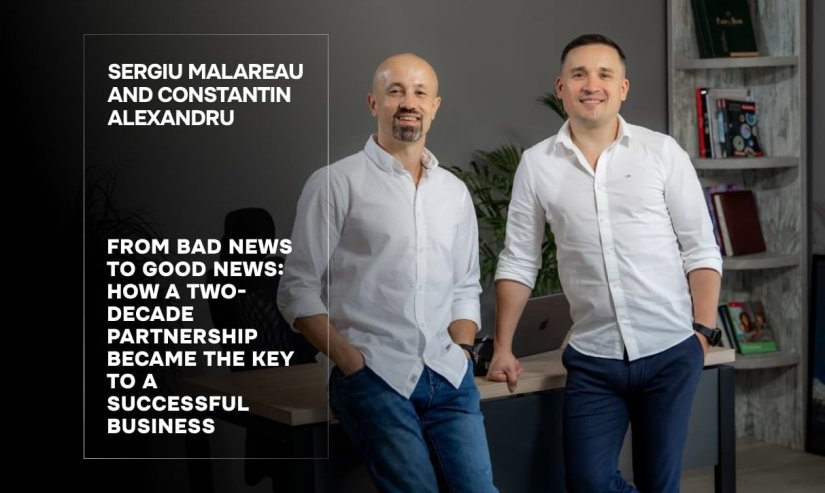

Interview with Sergiu Mălăreau and Constantin Alexandru, co-owners of SCOP Distribution
Sergiu, Constantin, the story of your friendship, and later your joint business, started many years ago. Today your company is a major distributor, but the beginning was quite unusual – with IP telephony and sports betting. Does that mean you started out by bringing people either bad news or good news?
(Laughs) We never thought about it that way, but you’re right!
People received calls from abroad with all kinds of news. We often saw them laugh or cry in the booths while talking to their loved ones. It was the same with betting: some would win and be happy, others would lose and cry. Though in that case, crying was more frequent.
And how did you get to the point where now you only bring good news?
The evolution of the business led us to a clear understanding: we want to be the ones who solve clients’ problems, not create them. Today our mission is as simple as it gets – to provide the right products, of the right quality, at a fair price and within a reasonable time. That’s always good news. And in business, unlike in the media, good news sells best.
Tell us, how did it all start back then?
We’ve been friends since we were 16, studied together in Orhei. From a young age we were ready to take on any job, as long as it meant earning something. Starting locally was easier than moving straight to Chișinău. That’s how, almost twenty years ago, in 2006, a small IP telephony center for international calls appeared, and at the same time we accepted sports bets.
Later we moved to the capital and tried our hand in all kinds of fields – household chemicals, wholesale sales of fish and meat, clothing retail, even growing strawberries. These “rollercoasters” lasted six or seven years until we found our core – trading IT equipment, mainly laptops. That’s when the first import deliveries began, the first relationships with retail chains, the discipline of supply – and the realization that systematic work pays off here.
From IP telephony to distribution – quite a transformation. How do you define your company today?
We are a large wholesale company, mainly engaged in B2B sales, but also active in other market segments – online sales, public and private tenders, and projects.
So how many sales channels do you have?
Four main ones. First – retail (supermarket chains), from Metro to Family Market, where it would be hard to find someone we don’t cooperate with. Second – online stores, where again, all the major names are among our partners. Third – corporate sales, mostly large and medium-sized companies that buy directly from us. This can mean complex technical equipment for a bank, or a coffee machine for a travel agency. Fourth – public tenders, mainly government procurement. Over the years, that means dozens of contracts, from the National Bank to a simple village mayor’s office.
Is all of this really distribution?
It depends on what we mean by that definition. Classical distribution is representing a brand in a specific territory – in our case, Moldova – and systematically developing it and building sales. But trade is a very volatile and dynamic field, where both obvious and not-so-obvious opportunities constantly appear. Our job is to spot them in time and profit from them together with our partners. Some call it trading, others arbitrage. So for us, it’s a hybrid form.
How do you find these opportunities?
It’s always different situations. Sometimes it’s a request from our partners, sometimes it’s our initiative. From the simplest ones like “summer will be hot – we need fans” to those where you can’t manage without experience and intuition developed over years. But even here, there’s nothing supernatural. Just two ingredients. First – opportunity through movement. A certain volume of activity, of movement, generates new ideas, collides them with each other, and out of those combinations opportunities are born. Second – opportunity through attentiveness. The result of your awareness and deep understanding of a specific field.
We’ve clarified the sales channels. But what do you fill them with? Do you specialize in any product groups?
From flowers to servers.
Are you joking?
(Laughs) It’s absolutely true! We have an impressive diversification: IT equipment, home electronics, household goods, sports goods and… indoor plants.
But how did such a combination come about?
Business rarely goes in a straight line: you never know what a new search or acquaintance might lead to. Remember we mentioned strawberries? While delivering them to stores, we kept an eye on the neighboring shelves – with exotic fruits, often of poor quality. We thought about developing that direction. That’s how we ended up in the Netherlands, but instead of fruits another project was born – supplying potted flowers.
How many people does it take to maintain such diversification?
We try to be efficient. To develop and retain talented and motivated employees. In 2024, our companies’ turnover exceeded 200 million lei. Behind that stands a team of 35 people.
Wouldn’t it be simpler to specialize in just one direction?
Maybe simpler, but the risks would be much higher. We have a different position and different life experience. To succeed in markets that constantly change, you need to be very flexible yourself and ready to react. For example, a few years ago, in response to growing regional tensions, we expanded into Romania.
Into Romania? Isn’t that market already saturated?
That doesn’t exist. And this is one of the main myths in business. We regret not doing it earlier. The market volume and development pace there are completely different. Moreover, we don’t limit ourselves to Romania. We have partners in Poland, Bulgaria, Germany, Denmark, the Baltic countries. We can’t yet say we work there as systematically as in Moldova, but we’re constantly expanding our presence.
If I approached you to get into retail chains and online stores in Moldova and Romania through you, where could I end up with your help?
In Moldova – practically everywhere. We work with the largest computer and electronics chains and with grocery chains, since they all also operate in the non-food segment. In Romania we’re still working on expanding our sales channels. But even now we’re present in Carrefour and Kaufland, in online stores such as eMAG and PC Garage.
What’s the secret of sustainable growth in such a competitive market?
The foundation is our partnership, tested by time and challenges. When you’ve known your partner for twenty years, trust becomes the basis for quick and correct decisions.
But looking back, we can say that without certain values it’s hard to succeed. In our case, these are our principles with clients: honesty, rationality, calculated risks, the ability to keep emotions in check in conflict situations, and the search for optimal solutions. We treat everyone with the same respect – whether someone orders one laptop or a hundred.
Of course, there are clients that are difficult. But emotions are a bad advisor. If you hold back once, twice, three times, you develop the habit of finding compromises that benefit both sides. In a competitive market, that’s critically important.
It all seems like common sense, but as Buffett says – to achieve incredible results, you don’t need to do incredible things. You just need to do the right things, long enough. We’ve seen that in our own experience.
It’s not common these days to ask about long-term plans, but still, how do you see your company’s future?
In the near future, expansion in Romania, first of all by increasing our presence in the largest retail chains and in direct corporate sales.
In Moldova, we’re working on creating another one or two of our own brands. We already have successful experience with a brand “built for us,” and we want to expand that line.
Also, in the long term we’re thinking about our own production. But starting requires serious investment – a couple of million euros today doesn’t cover the needs. Still, this plan also depends on how things develop in the region in the coming years.

 Life Principles


