




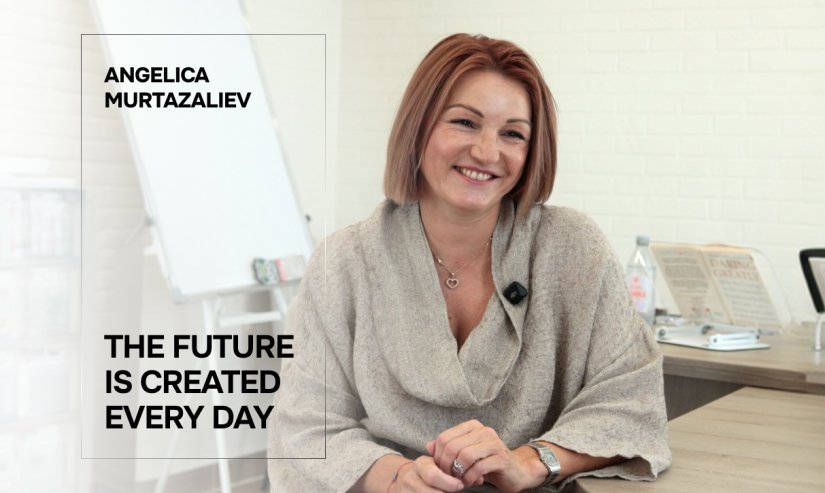

Interview with Angelica Murtazaliev, psychologist and coach
My childhood was all about «I'll do it myself». My father was an executive and lived at work – it was simply the way things were at the time. He could even spend the night out in the fields with his team. My mother was the chief economist and carried the responsibility for our home and family. From an early age, I got used to relying on myself. During my childhood, I changed schools three times, and each time I had to find my place among a completely new group of people. That was when I realized that life is constantly changing, and that what matters is not resisting change, but learning how to adapt to it.
My warmest childhood memories are connected with those rare days when the whole family was together. Every Sunday, we had what my father called a «family council». We would all gather together. When I look back on those moments, what I remember most is the feeling of belonging – this was our family, these were our values, this was the way we lived. Another memory comes to mind. My father almost never had time to go on vacation with us, but when I was eleven, we spent an entire week together by the sea in Odesa, at the «Moldova» Sanatorium. I will remember that week for the rest of my life. And then there was the evening when, after our guests had left, my father, my mother, my brother, and I danced around the table to Adriano Celentano's music. If you asked me today what happiness is made of, I would say it is made of moments like these.
My favorite dish has always been stuffed lamb. I come from Bashkalia, a Bulgarian village on the border with Gagauzia. Perhaps that is why, from childhood, I grew up at the crossroads of different cultures, traditions, and cuisines.
I vividly remember my mother’s laughter. She worked all day and already had health problems at the time, but when she laughed, she could be heard across the entire courtyard. People in the village would even say, «You can hear the chairman’s wife laughing».
My father always knew how to stay true to himself. He knew how to go against the rules, how to charge at a tank with nothing but a saber, and how not to fear the consequences. The greatest lesson he taught me came after he was gone. That was when I realized that I would have to take full responsibility for myself. I thought I had been doing that all along, but deep inside there was always one thought «Dad is there». And that is a very dangerous trap. As long as there is a bridge you can cross to return to a place that feels safe and comfortable, you will never truly move forward.
Life is about being afraid, taking risks, falling in love, trying something new, and not knowing how it will end. There are no perfect people, and there are no ready-made answers. Each person has to find their own.
We can explain to a child a hundred times how to live the right way, but they will still develop their own view of the world. But if, every day, they see something in the example we set at home, there is a chance they will carry part of it with them into their own life.
If I could give my daughter just one book, I would choose «The Heroine's Journey». A woman's path is not the same as a man's. This book helped me realize that the answers are within you. And every person with whom you experience a major conflict is, in fact, telling you something about yourself – not about them. I believe that behind every great conflict lies the greatest opportunity for growth.
I often come back to «The ONE Thing». Today, there is so much chaos and an overwhelming amount of information around us. We used to live in a single village, surrounded by people we knew, and making decisions was much simpler. Today, it is very easy to lose your focus. It is important to stay in your own lane. To live your own life. To remember your own goals and what gives your life meaning. To follow your own path without scattering your energy on someone else's.
I agree with Viktor Frankl that a person without purpose is in a very dangerous place. If I hear something that I can bring to a person's attention, I do it. I believe those are exactly the small things that lead to the biggest results.
My mission today is to create myself every single day. If a person does not wake up asking themselves, «Who am I creating today?» old patterns and old ties will quickly pull them back. But if you do it consistently, like any other form of training, you can consciously create yourself. It is always better to begin with yourself than with others.
There are things I can control, and there are things I cannot. But I can create my future every single day. And that depends on me. When I face a situation I cannot influence, I focus on what I can. I can breathe. I can walk. I can take the next step. I always move from the small things to the big ones.
A problem is always a symptom. You always have to understand what caused it before you can move forward. What has always helped me through the most difficult situations is working on my mindset.
Fear is a natural human state. I do not watch television, and I do not want to consume information that has nothing to do with me. Very often, fear is passed from one person to another. That is why I always talk about inner anchors, inner values, and inner principles that can help you find your way out of that state. Do you know how to deal with fear? Go brush your teeth. Go wash the dishes. Go do something. Simple actions – taking care of yourself, your mind, your body, and your work – gradually restore your sense of stability.
And then the fear fades away.
The most valuable thing I learned from Robert Dilts was humanism. To remain human, no matter the circumstances. In my work with Robert Dilts, we often talk about how to help a person carry the weight of responsibility when someone will inevitably be hurt, and how to keep moving forward without losing themselves. Every answer he gives reflects genuine care and compassion for people. Perhaps I needed to meet people like him to realize that there are those whose mission and purpose in life are simply to care for and love others.
Milton Erickson was born with severe health problems, and by the age of sixteen he was lying in a semi-coma. A doctor told his mother that he would not live until morning. He heard those words and, with nothing more than the movement of his eyelids, signaled to his mother to turn him toward the window. And he said to himself, «If I see the sunrise, I will live». He lived to see the sunrise. He then went on to live a long life and helped thousands of people. What matters most to me in this story is his determination and his refusal to give up on his goal. And Erickson's words have stayed with me «Every question already contains its own solution».
Mozart, upon finding two notes that, as he put it, loved each other, could build an entire symphony from them.
I am drawn to people who do not come to me looking for answers to their questions, but in those who find the answers themselves. People who are constantly working on themselves and developing new cognitive habits. One of my clients once said, «For me, what we do has become as natural as brushing my teeth». I really liked that comparison.
The real challenge is that we need to change our habits and our beliefs. And to do that, we first need to understand why, to understand what for, and to see exactly where those habits and beliefs are preventing us from living fully and from being truly human.
I am drawn to people who have created something of their own, who have taken responsibility, and who have a vision. I love the moment when we begin to create something tangible out of nothing. It is much like the work of an architect. There is an empty space, and together we begin to discover what kind of building it is going to become.
I am drawn to people who go all the way. People who do not give up. I never know where our journey will lead. I never have the answers. I always have questions. Some questions reveal a great deal about a person. And from there, everything else begins to unfold.
Cancún, Mexico, and the ocean. We had traveled there for my husband's competition, but for two days we did not go into the water because the waves crashing onto the shore looked enormous. Then one of the judo athletes simply walked into the ocean. He went in, and I found the courage to follow. No matter how vast the ocean may seem, once someone has already stepped into it, it no longer feels quite so frightening.
I like simple things that carry a great deal of strength. I like a beautiful stone. I like wood. I like water. I need simplicity. When there is too much of something, it gets in my way. For the past two years, I have been giving away my belongings. I keep only the things I need for the current season. I give the rest to relatives, acquaintances, and people I do not know. And suddenly you realize that you have been carrying so many unnecessary things for such a long time. They weigh you down, and you begin to long for lightness.
We grow by allowing ourselves to be vulnerable with another person. The problem is that people are becoming increasingly isolated. But how can you touch the strings of your own soul if there is no one beside you? I believe it is precisely moments like these that keep a person from closing themselves off. We are shaped by the people we communicate with. On our own, we remain confined within the limits of our own thinking. People need people.
My husband has just opened his third children's judo club in the city. We have been together for 26 years. There were times when we had money, and times when we had very little. We traveled to competitions because he competed himself. Now he has opened his third club. One day I asked him, «Why did you open it?». He answered, «These children will always remember their first coach. It matters who gives you your very first lessons and who is the first to shape you». Yesterday I visited him at the judo club. The only other time I have seen my husband this happy is when he is looking at our daughter. He was standing there in his gi, surrounded by what must have been fifty children. Watching him from a distance, I found myself wondering, «Are those tears in his eyes?». There was so much love in that moment. Perhaps that is what passion really is. That is what the love of life looks like.

 Business and Lifestyle


