




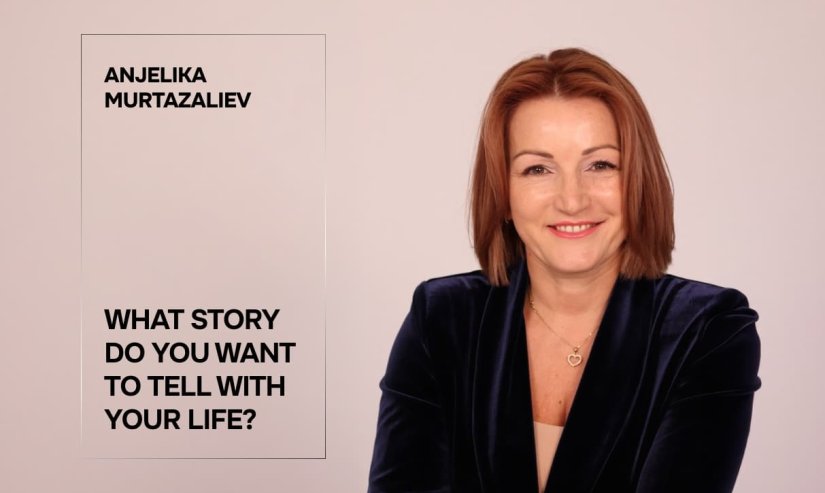

Interview with Angelica Murtazaliev, psychologist and coach
By the time we finished this interview with Angelica, one idea had become very clear: her approach to working with entrepreneurs is not designed for everyone who comes to her for help, but only for those clients whose values align with her own. If only because, after her four foundational sessions, the real work is only just beginning.
"Why not apply her approach to this interview as well?" I thought.
So I decided to create a short summary of the interview, allowing you to decide from the very beginning whether you want to continue reading.
So, if Angelica's views resonate with you, then this interview is definitely worth your time.
"Business does not begin with strategy—it begins with the individual." This was probably the central idea of our entire conversation. Most business problems do not originate in marketing, finance, or sales, but in the entrepreneur themselves. Their mindset directly influences the results, which means that the right sequence is to first understand the person and only then the company.
"The main task is to help a person find their core." By "core," Angelica does not mean talent or profession, but rather a person's own identity, stripped of other people's expectations.
Angelica offered a powerful metaphor: a person spends years climbing a ladder leaning against a wall, only to reach the top and realize that the ladder was standing against the wrong wall.
"Many people live according to someone else's script." I completely agree with this statement. In fact, most of us do. And yet, for some reason, we often lack either the time or the support to realize that we may be living out our parents' expectations, fulfilling other people's ambitions, and building a life that is not truly our own.
Another idea that resonates with the previous one—and one I have experienced personally—is that "an entrepreneur gradually begins to belong to their business." It happens often: first, a person builds a business. Then the business begins to "build" the person. Angelica believes that the role of a consultant is to help a person return to themselves.
"Change requires action, not endless analysis." There is a great story in the interview that illustrates this idea. I won't spoil it—it is practically a ready-made case study for a public speech or presentation. Perhaps it will be useful to you as well.
And now—the interview.
Angelica, good afternoon. A little more than a year ago, we did our first interview together. At that time, the focus was on coaching and NLP, and on the idea that for a person it is more important to form the right vision of the future than to endlessly analyze the past. What has changed in your approach to working with clients?
First of all, I have focused my work on entrepreneurs. To one degree or another, all entrepreneurs are creators, and I find this type of person both attractive and easy to understand.
Secondly, I have removed a lot of what I used to do before. Probably because it has become much clearer to me what exactly I want to convey to entrepreneurs.
There is one idea that I keep coming back to again and again: if a person does not see the connection between their thinking and their business, eventually both the business and the person begin to suffer.
Do you have your own method of working with entrepreneurs?
Yes. Together with my clients, we work on what I call a personal strategy.
Because from my life experience and my knowledge, I see that when there is not enough inner capacity inside a person, the business suffers. In everyday life, I speak five languages. In my sessions, I also speak the language of business. For an entrepreneur, it is very important to understand why they should change something. We can talk about health. We can talk about relationships. But when you show how a person's internal state begins to affect their business, a completely different level of attention appears.
After all, an entrepreneur is someone who truly lives through their work.
Isn't there a danger that, for an entrepreneur, business begins to overshadow everything else—including family, health, and life itself? After all, a person's identity cannot be reduced to business alone...
There is a certain paradox in this devotion to business. At first, it is precisely because a person gives themselves entirely to the business that the business begins to grow. But then something else happens. At a certain point, the business starts to take possession of the person. And many people do not even notice when this happens. That is why I always say: first the person, then the business. Growth, new projects, and new opportunities are captivating, but if all your efforts and all your thoughts are directed only toward what is outside of you, it becomes very easy to lose yourself.
"Yourself"—that already sounds like the language of philosophy. It's not so easy to understand yourself, to understand who you really are...
After many years of talking to and observing people, I have come to see that very often they are not living their own lives. We adopt the scripts of our parents, of people who are important to us, of society, and gradually begin to believe that this is who we are. Let me give you an image that explains this quite well.
Please do...
Imagine a person who places a ladder against a wall. They spend years climbing it. They work hard. They overcome one step after another. Eventually, they reach the very top. And suddenly they realize that the ladder was leaning against the wrong wall all along. And that what they see after all those years of effort is not something they like at all. It is precisely at that moment that a person begins to ask themselves the questions they had avoided before. Questions about who they are. About their true desires. And about what story they want their life to tell.
And if a person realizes that the ladder is leaning against the wrong wall, what happens next? How do you work with that?
For a long time, I was searching for a format that would truly help a person not just gain an insight, but actually begin to change something. Gradually, it all came together in the form of four strategic sessions.
Exactly four? What are they about?
The first session always begins with a single question. I ask the person to tell me about their core, about their fundamental essence. More often than not, this question becomes so engaging—because very few people can answer it immediately—that it sparks a genuine curiosity. I might receive messages late at night or early in the morning saying, "I think this is what defines me the most. Have I found my core correctly?" And then I ask my own question "Do you want me to answer and give you someone else's opinion once again, or do you want to find it yourself?"
The session about the "core" is clear and logical as a first step. What is the second session about?
About limitations. Almost everyone has them, and they are different for each person. They are the things that prevent us from reaching a greater scale, greater income, and the next level.
The third session is devoted to marketing. Because after internal changes take place, a person begins to talk differently about themselves and about their business.
And the fourth?
The fourth is integration. Because any change has to be integrated into life. There are strategies for generating something new. Those, too, need to be learned and applied.
So the four sessions make up a complete program?
No. Quite the opposite. They are more like a filter, because not every entrepreneur is ready to change themselves. Sometimes a person prefers to keep squeezing everything they can out of the business rather than change themselves. And I am interested in working with visionaries, with people who are willing to change themselves first and foremost.
After the four sessions, do you finish working together, or does the process continue?
Very often, it continues. Because by that point it becomes clear whether we can be partners—not simply a consultant and a client, but people who are capable of working together over a long period of time. Even during our previous interview, I was already trying to work this way, but back then it was more intuitive. I made many mistakes, and the biggest one was continuing to work with people whose values did not align with mine. Today, I no longer do that. Because if you are going to continue the journey together for a long time, shared values become essential.
I know that you are a board member of several businesses. Does that mean that some of your clients continue working with you under arrangements where you become their business partner and begin sharing both the profits and the responsibility?
It is always individual, but you have formulated the essence correctly. At the same time, if we are talking about sharing responsibility, I am not referring to business processes. I do not work with CRM systems or the organization of a sales department. My responsibility does not lie in the business processes of my client's company. My area of responsibility is the transformation of the person themselves. And that is not a process of a few months. Sometimes it is not even a process of a few years. But my fundamental principle is that the desire for change must come from the person themselves. If there is no desire, there will be no positive change. It is very important that a person begins to act...
I remember a phrase from a book "To analyze something to death..."
That happens. I had a client who thought and weighed every option endlessly, without ever moving to action. One day, during a session, he spent almost fifty minutes just thinking. It wasn't an online session—we were in my office. And on the wall of my office, I have a dartboard and a set of darts. I stayed silent that entire time as well. Then I stood up, handed him a dart, and asked him to throw it at the board.
And?
He threw it and missed the target completely. Then I told him: "The same thing happens in life. You think you're going to hit the target. But first you have to start doing, see your mistakes, correct them, and keep moving forward. There is no other way." Real change only begins after action.
Listening to you, I realize that over the past year not only your product has changed. It seems to me that your expectations of your clients have changed as well.
Probably yes. I stopped working with everyone. It is important for me to understand that a person genuinely wants change. That they are not simply trying to solve another problem or earn more money, but are willing to take a closer look at themselves. I understand very well that this path is not for everyone, and that is perfectly normal.
So today you choose your clients just as carefully as they choose you?
Yes. There was a time when I believed that I needed to help everyone. Today, I no longer think that way. Because real change always happens from both sides, and responsibility also always lies with both sides. I can ask questions. I can point in a direction. But it is impossible to walk the path for another person.
We began our conversation by talking about how much has changed in your work over the past year. If you had to end with a single sentence—what matters most to you today?
Probably helping a person stop living someone else's story. Very often, an entrepreneur tells their personal story through their business without even realizing it. And that is when I always find myself asking one question: is this really the story you want to tell? Because when a person finds their core, balance appears, harmony appears, and most importantly, the joy of what you do appears as well.
Then one final question. Who should come to you today?
Probably not every entrepreneur. If a person is looking for a set of ready-made answers or quick solutions, then I am probably not the right person for them. But if, at some point, there is a feeling that the business is growing faster than the person themselves can keep up with it... if a question arises inside them: "Is this really my life? My path? My story?" — then I think we would have something to talk about. Because sometimes the most important strategic question in business is not about the market and not about money. It sounds much simpler: "Who is in control of my life today — me or my own business?"

 Life Principles


