




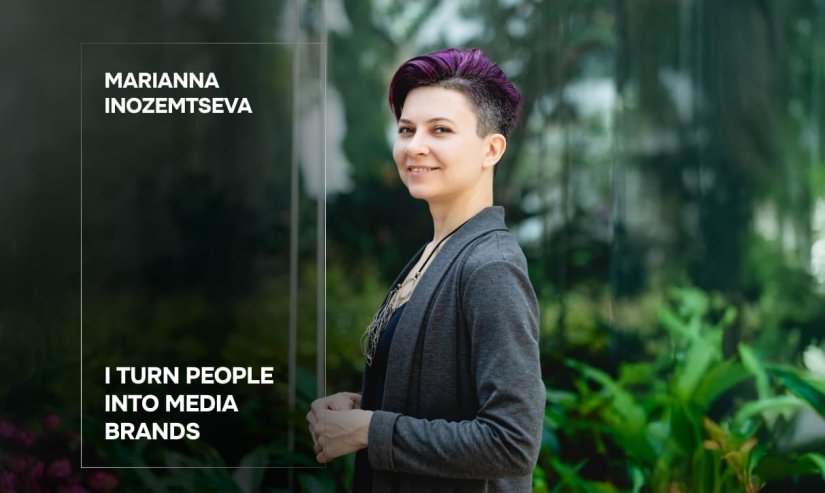

Interview with Marianna Inozemtseva, founder of Linkifyo Agency.
Marianna, good afternoon! I’d like to start with a question that often makes my interviewees stop and think - what’s written on your business card? Because sometimes a person is involved in two or three different areas, and when asked, “How should I introduce you?”, they reply, “Honestly, I’m not even sure how to define myself.”
That’s a really great question because the last time I had a physical business card was probably about ten years ago. Now my business card is my LinkedIn profile. It says that I’m the founder of the LinkedIn agency Linkifyo and a LinkedIn strategist.
My main goal is to help business founders and executives achieve online visibility so that their online networking strengthens the real human connections they’ve built throughout their lives. This helps them solve concrete business challenges. Linkifyo Agency is, first and foremost, me - my knowledge and my network.
Let’s go back in time, because none of us were born as the founder of a LinkedIn agency. I’m curious about your background - what did you do before LinkedIn?
If you imagine my virtual CV, before launching my own agency I was leading the brand ambassador program at Yango Ads. It’s a technology corporation that offers a wide range of digital marketing products and manages a massive advertising network. Basically, my team and I there were doing for 40 top managers and executives what I now do for my individual clients.
Before that, I was heading the corporate blogs editorial team at TProger, a media platform focused on the IT industry. We helped companies connect with professionals from the IT world - some needed to hire DWH analysts or other rare specialists, some wanted to sell their server capacities, and others aimed to promote their startup hubs. It was a wide range of cases, but excellent multitasking practice.
And before that, I worked at a marketing agency called IT-Agency, managing a blog about marketing that actually served a very similar purpose - attracting new marketers to the team and bringing clients to the agency.
Before all that, I had my own event agency focused on the artistic community. Maybe because before that, I myself was an artist.
So we’ve reached the origins! Were you an actress? Did you sing?
No, I performed fire dancing and light painting - I had a performance group of artists and visual performers called Aurum. It actually still exists today; it remained with my former business partner.
When I watch fire shows, it always seems like a very meditative experience - working with fire. Is that true, or does it just look that way?
Well, maybe when you’re dancing on stage, it feels meditative. But when you need to manage 35 people and make them perform in sync, it’s not very meditative - it’s more of a “sergeant instructor” kind of mode.
Let’s come back to the present. You moved to Israel two years ago, right?
Almost three now. I moved in the fall of 2022, when we learned about the emergency repatriation program. I came here, and we began the repatriation process directly in Israel. It was quite stressful because it wasn’t clear how everything would work - whether my documents would be accepted, what the procedure would look like.
After moving to Israel, did you take a professional break, or did you already have online clients so it didn’t matter where you were based?
As I mentioned, even back in my artistic career I was already managing people, and besides that, I was responsible for marketing in our team. Marketing, PR, partnerships - a big part of that was on me. So I’ve always worked online, and remote work has always been my natural environment. That’s why when I moved to Israel - and before that, when I worked in marketing, in agencies, or in editorial roles - it was all done online.
How did your adaptation to the new country go? It’s often quite difficult to build new contacts and useful connections from scratch.
When I moved to Israel, I basically had nothing except good English and an understanding of how social media works. I started going to meetups and events, figuring out what was happening in the region, joining chats with English-speaking marketing professionals from Israel’s high-tech industry, and gradually building new connections.
I began helping the guys from the RU IT in TLV community organize events, manage their social media, communicate a bit, and find media partnerships. At the same time, I launched my LinkedIn blog in English and a Telegram channel in Russian, where I talked about my work. And through this community - after people saw examples of my content - I was offered a position at Yango Ads to promote their employees on LinkedIn.
Can we say that you specialize in the IT community? Are your LinkedIn clients mostly IT professionals, or do you also work with other industries?
I would say I specialize not in IT, but in complex B2B. There’s a big difference, because IT can also include fairly simple B2C products - like a personal finance tracking app: you just download it and use it, everyone understands what it is.
My clients, on the other hand, usually sell something big, expensive, and complex - sometimes to government institutions, with deal cycles that can last up to a year. Of course, I also have clients from IT: data science, cybersecurity, banking compliance platforms - quite a variety.
So, it turns out that most of your clients are those who sell B2B products and services?
That’s right. My clients are typically those who sell complex, high-value products or services, where investing in building trust-based relationships with potential customers is completely justified.
The products and services my clients offer can be described like this: they’re expensive solutions that require a high level of trust before purchase. For example, you can just go and buy a car from an official dealer - everyone understands the product, you simply go and buy it.
But my clients’ products and services are usually aimed at a very specific and narrow audience - for instance, AI directors at banks. Naturally, these buyers are top experts in their field. And before they buy something from a vendor, they need to be sure that the vendor is also an expert - someone who truly knows how to solve such complex problems. Deals like that simply cannot exist outside of real human communication.
Can you share some examples? It’s always easier to understand through them.
Of course. I can tell you about a few case studies that will make things clearer.
One of my clients works in the IT niche. Their product focuses on security when working with large language models (LLMs). They collaborate with Fortune 500 companies and unicorn startups.
Okay, so it’s a cybersecurity solution for large enterprises. I’m sure that’s not the only one, judging by your experience.
Correct. For example, one of my favorites - Decision Science. It’s a consulting company, about twenty percent of whose team members hold PhDs. They consult corporations with massive volumes of data, showing them how to integrate the latest scientific advances into their business processes. You’d be surprised how much abstract mathematics, which seems far removed from everyday life, actually influences, say, the price at which an airline sells you a ticket.
Shall we go on?
Let’s add another example. There’s a company that specializes in public space design and navigation systems - for stadiums, airports, factories, or even entire city districts.
A navigation designer? You mean signs and direction boards?
It’s a whole science. It’s not enough for the system of signs to simply match the design and atmosphere of the space. Navigation in large-scale environments means managing people’s attention - sometimes in stressful situations. Think about yourself in an unfamiliar airport: you have a connecting flight, but your previous one was delayed. In a well-designed navigation system, all you need to do is look up, and immediately you’ll know where to go and how to get there. That’s exactly the kind of navigation my client develops.
Agreed, that’s a very niche field. And the clients there are definitely unconventional too - a great example of complex B2B sales and negotiations. So now it’s the right time to ask: how does working with you actually start? Let’s say I’ve decided to become your client - what’s the next step?
We always start by clarifying your goals. What exactly is your product or service? Who is your target audience? And is this audience actually present on LinkedIn? For example, I know for sure that in Central Asia and the Middle East, the audience is there. But sometimes I still need to dig deeper - to find out how large it actually is. Because if the focus is, say, on Latin America, then half of the companies you’re targeting might simply not be represented on LinkedIn.
And will we be promoting my personal page or the corporate one?
In the kinds of complex projects I take on, trust is the key factor. And trust is built, first and foremost, with the person who will come to the negotiations - the one who will likely be signing the contract. So it’s that person who must be the voice of the company.
As for corporate pages, my clients usually already have an in-house SMM department within their marketing teams that takes care of those.
I didn’t ask you yet - what exactly does your process include?
I’m an expert who guides you through it. So I work directly on both strategy and content creation. At the first stage, my job includes developing the overall strategy as well as filling out and optimizing your profile. That’s our personal landing page, the place where we’ll be bringing in your audience.
After that, we move on to connecting with the right people and creating content. Ideally, a person should publish two to three posts per week so that their profile grows organically and remains visible.
So the strategy is a separate product?
Exactly. The first stage is always strategy development and profile setup. It’s a standalone product that takes seven business days and costs $1,500.
As a result, you don’t just receive a list of recommendations - you get a fully completed, meaningful, and algorithm-optimized profile, along with a content strategy that includes a description of the target audience and approaches to engaging with it. This also covers content streams, a thematic plan for the first month, and your first post.
Once the strategy is approved, we move to monthly management. If you take the full package, it starts from $2,000 per month. This includes three to four posts per week aligned with the strategy, handling incoming messages, filtering irrelevant contacts, responding to relevant ones, sending connection requests to the right people, managing comments (both incoming and outgoing), and even creating entry points to the right people outside of LinkedIn.
For instance, if I know an investor in my network who’s interested in medical technology, I’ll happily introduce them to another client who develops digital solutions for hospitals.
I see. So your strategy includes much more than I initially thought - it’s not just an action plan but also a fully set up profile aligned with that strategy, ready to move forward?
Exactly. I’d also add that, besides posting, outgoing activity is very important. For example, I can act as an assistant managing your inbox. If someone receives a lot of DMs, friend requests, or spammy offers, I clean up the irrelevant ones. But I always ask my clients to personally monitor their messages too - it’s important that they are present in their own profile where their expertise is needed most.
Is there anything important about your work that we haven’t covered yet?
I think it’s worth emphasizing the human connection aspect. I help people connect faster and more meaningfully with the people they actually need. It’s not just about posting into the void - it’s about analyzing reactions, understanding who’s reading, and using that for strategic engagement.
We often run small special projects - such as collaborative posts or mini-interviews. The client’s LinkedIn profile starts to function like a media outlet. I create situations where a network of expert interactions begins to form around the person’s name.
For example, we might take one strategic topic and ask 4–5 industry leaders for their opinions. We then compile it into a mini-interview, tag those experts, and spark a discussion. It’s not a post for likes - it’s a way to enter the network of decision-makers.
This way, the person demonstrates that they’re truly in the field: they know the problem exists, they have a perspective on it, they’re aware of other smart people whose opinions matter - and the community recognizes that.
And those people comment, saying things like “Thanks for starting such an insightful discussion.” That’s how your profile begins to function as a personal media brand.
My final question - what important thing did I miss?
A very important part of my work is direct communication with the profile owner. I work only with the founder or key decision-maker - not through assistants or PR departments.
LinkedIn is a space of personal trust, and trying to delegate your personal presence always leads to loss of results. This isn’t about playing influencer - it’s about deals worth millions. I don’t want any “Lost in Translation” moments.
Yes, yes - that scene from the movie, where after a long speech from the director, the interpreter just says, “Make it more intense.” A brilliant moment.
Exactly. To avoid that kind of “translation issue,” I always prefer to communicate directly.
Actually, it’s not just a preference - it’s the only condition under which I agree to work with a client. Otherwise, it’s just a waste of both time and money.

 Life Principles


