




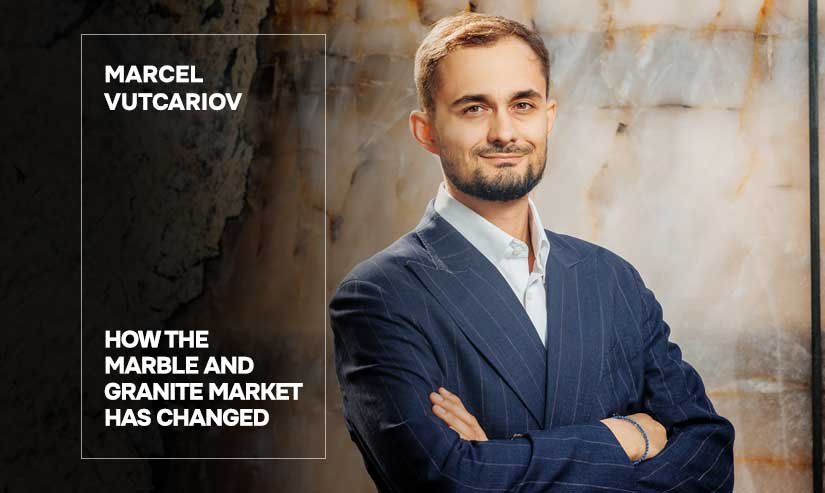

Interview with Marcel Vutcariov, Owner of Art Granit
Marcel, hello. I looked back at our previous interviews and realized it’s already been two years since the last one. So the first question writes itself: what’s changed in the Art Granit business?
The biggest shift has been in customer behavior. The pandemic, followed by the outbreak of war in our region, radically changed how people consume. In our line of work, the premium and luxury segments have moved to the forefront. The reasons are pretty clear. The middle class has less disposable income now. The economic situation, including rising interest rates, has taken a toll.
As often happens in times like this, the wealthier segment also saw a drop in income, but it affected their consumption patterns differently. They’ve become more selective and are now leaning toward premium and luxury products.
Sounds like this trend isn’t limited to just marble and granite as construction materials.
You’re absolutely right. Looking at the range of products we offer and work with in Moldova and Romania, we’ve noticed people increasingly choose higher-quality materials—ones less influenced by trends or time. And that’s not just true in our field. We’re seeing similar patterns in other industries, like fashion. The focus has shifted toward luxury brands. People may buy fewer items, but they want them to be made from the best, most durable materials.
Just like fashion designers, architects are choosing materials best described by the English word timeless. By the way, that’s one of the signs that we’re in a crisis.
You think a “crisis” doesn’t necessarily mean “reduced consumption”?
There are certain patterns in how people behave during a crisis—I see it in our work and in my own observations. In tough times, people cut out impulsive or unnecessary spending, but when it comes to things that really matter, they tend to choose higher-quality, even if more expensive, materials.
There’s another strong trend that’s increasingly shaping how people behave, and it often has nothing to do with their financial situation.
What trend is that?
People are paying more attention to sustainability, although the English term sustainability captures the essence of it better.
I feel like that word still means different things to different people—it’s not quite settled in our minds yet.
I’d define it as being aware of how our actions and consumption impact the environment. And that doesn’t just mean non-recyclable waste or CO2 emissions. Hiring underage workers or underpaying employees is just as much a violation of sustainability principles as plastic waste is.
What matters is that every person—from business owners to workers to students—understands that sustainability starts with their own behavior.
So how has Art Granit changed its business approach when it comes to sustainability?
We’ve made changes across several areas, including production emissions. Our experience in Romania helped with that—there, our operations are under strict monitoring for compliance with EU regulations.
Even though Moldova’s legal requirements haven’t caught up yet, we’re already implementing the same standards at our Chisinau facility. For instance, we treat all the water used in production and reuse it—basically creating a closed-loop water system for industrial use.
We’re also analyzing other types of production waste, exploring how they can be recycled—not to make a profit, but to find ways to reuse them sustainably.
But all of this must affect the final cost of the product, right?
You know, Art Granit only imports products that meet European standards, and we work with companies and countries that follow sustainability principles. Respect for the environment isn’t just a buzzword for us or our partners.
For example, the owner of the Spanish company we import Dekton from is actually the largest private producer of green energy in his country—he’s built a massive solar farm.
That’s why Art Granit will never put price above principle. If we did, we’d become a toxic company.
But competition still exists…
Still, take a look at some recent projects in central Chișinău—clients there chose suppliers through tenders and, of course, considered price as a factor.
Name a few.
The office building at the corner of Ștefan cel Mare and Lazo, which was finally completed after many years. At one point, they even started cladding the exterior with ceramic tiles. But then the developer compared the overall project cost and the purpose of the building with the price difference for using high-quality facade materials. In the end, the entire exterior at ground and first floor levels was done with premium granite supplied by Art Granit.
The new office building right across the street on Ștefan—that’s ours too. Exterior work includes granite and marble. We've been working with them for two years now and there haven’t been any complaints about the quality.
Makes sense—“saving” on materials for such projects could end up costing a lot more down the line during operation.
Exactly. That’s why two more major new office buildings in the city center—on Mihai Viteazul—are also our clients. Royal Tower, where we supplied marble and granite for both the exterior and interior. And the building with more classic architecture across from it—that’s our work too, we did the interior finishing.
So it’s not just Art Granit that doesn’t put price above all else?
And that’s definitely encouraging. But it also depends on what the price actually includes. A price may seem higher at first glance, but…
But?
But that price might be for just the raw material—or it might include a complete solution. Our pricing covers logistics, selection, processing, installation, warranty, and after-sales service. In construction, you have to consider not just the purchase price but the cost of ownership.
What’s the point of saving money now if in five years you're already dealing with replacement or repairs, when other solutions could last twenty-five years and save you on maintenance costs too?
How do Art Granit’s materials affect operational costs?
We’re talking about ventilated facades. I think, just like there was a time when the quality of a building was judged by whether it had double-glazed windows, now it’s ventilated facades that play that role.
Dekton is mounted on an aluminum frame, with a minimum lifespan of 20 years—and it reduces energy consumption for heating and cooling by 20% year-round.
Right now, we divide construction projects into three general categories. “Standard” is the entry level, where price matters above all else. “Premium” is much higher quality—there’s a landscaped courtyard, a proper lobby, and people want their surroundings to look good, because our environment shapes our lives.
And then there’s “Luxury,” where it’s not just about materials—it’s about possibilities: 24/7 concierge, added services for offices and apartments, and even different neighbors, since price becomes a filter.
Art Granit works in the second and third categories, and our clients and like-minded partners work with us there too. You can’t overstate the importance of the environment people live in—how much it affects our quality of life.
Totally agree. A year ago I moved apartments, and it felt like I changed cities—or even planets.
Yeah, we could talk about this for hours. Let’s wrap it up with one last question—what are your plans?
Our whole conversation has really been about our plans and how we operate. But to speak more concretely: we’re focused on taking material quality to a new level. We’ll be importing larger slabs, which are easier and better to work with.
Also, this year we’re launching a new financial tool for our clients, developed in partnership with a bank—an interest-free installment plan for 24 months on all our materials and services.
Fantastic. But I’m holding you to one thing—no more long breaks between interviews. Life’s moving fast, and we need to keep the updates coming.
Deal.

 Life Principles


