




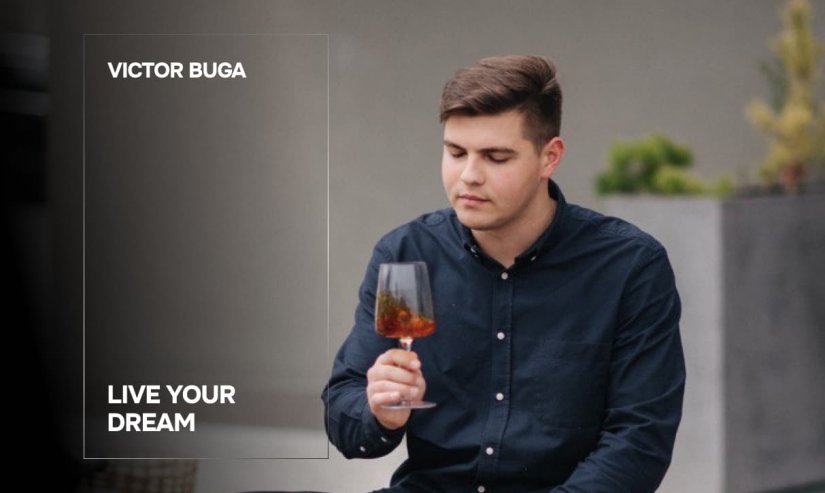

An interview with Victor Buga, Smart Coffee Service
This introduction is necessary, at the very least, to avoid any confusion about names and the brands associated with them.
I think I’m not the only one who could, without hesitation, name families in Moldova where the third generation of winemakers is already at work. But can you, without thinking twice, name a family in Moldova where the second generation is already running a coffee-related business? I can.
That’s the Buga family. Victor Buga, now firmly associated with the Julius Meinl brand. And Victor Buga, his son, who is leading the Smart Coffee Service brand.
On my way to meet Victor Buga (junior), I recalled my recent interview with Christina Meinl, when she visited Chisinau not long ago. I wanted to get her talking, so I told her the story of the most memorable cup of coffee in my life. It worked. In response, she, visibly moved, told me about her cup.
So my first question to Victor was exactly that: Do you have “that one” cup of coffee?
After all, coffee is a pretty cool business. On the one hand, it’s entrepreneurship, numbers, just like in any other industry. But on the other hand… coffee is pure emotion!
So I asked Victor: Do you have your own “that one” cup of coffee?
Here’s his story:
"Well, honestly, my story with 'that cup' is kind of funny. Our family is very organized, and I’m the opposite—nothing by the book. The family does things one way, I always do it differently. Exactly seven years ago, to the day, I decided to move out from my parents' place.
My mom and sister had gone on vacation to the seaside, to Bulgaria. Only my dad was still at home for a couple more days—he had work. I was 19. And I made the decision to move out. Somehow, I convinced my dad, we quickly found some apartment, and before he could change his mind, I moved all my 'stuff' in there—basically, my clothes and a couple of cups. That was all the kitchenware I had.
Back then, we were just starting to work seriously with specialty coffee, and I had this bag—I still remember it—blue packaging with whole coffee beans. But I had ground it about six months earlier, at the office, so by then it had really lost its aroma. And I also had this red cup, half a liter, at least.
So there I was, my first day in the apartment, alone. I took that coffee, boiled some water in a kettle, found a tablespoon—you know, the kind you’d use for borscht—scooped the coffee into the cup. I even added sugar, because I already knew what kind of coffee this was going to be. Poured the boiling water over it, stepped out onto the balcony, and drank my first cup of freedom. That cup of coffee—that’s my 'one and only'. Coffee with the taste of freedom."
And now—the interview.
Victor, hi. We’ve sorted out the story behind that cup of coffee. But we haven’t talked about your coffee journey yet.
I know that by the age of 19, you had already competed in three barista championships in Romania. And reached the finals in all three.
So how old were you when you first got into coffee?
I actually got into the business side of it before I got into coffee itself. I was 10 years old when my dad received, I think, his first shipment of Julius Meinl coffee. Back then, I didn’t even drink coffee—I only liked hot chocolate. And of course, I loved hanging out at my dad’s office. I got to see him more often, and he was always happy when I was around. I still remember that day clearly—I was 10, hauling boxes of Julius Meinl coffee, helping unload them.
Third grade? When most kids prefer goofing off?
Yeah, but I’ve always loved helping my parents. At 14, I had this serious urge: “I want to work during the summer!” So I spent three hours a day working at my dad’s office—inputting data from paper forms into the computer—and then I’d go help my mom in the kitchen at the restaurant. Back then, we still had the restaurant, downtown, on Eminescu Street.
Next to Karavan? Big Deal—I used to go there. So when did you actually learn to make coffee, if by 19 you were already competing?
When I was 15, I started pestering my dad to send me to barista trainings so I could work with him at events.
Do you remember the first event where you worked solo?
Of course! December 24th, 2016. Land Rover showroom. A Christmas event for kids and parents. I was on the second floor, with a coffee machine, making hot chocolate and coffee. I wasn’t even 16 yet. And by 17, I was already managing the Trabo Plus contract.
With Andy’s?
Yes. 54 locations, 45 of them in Chisinau. I had to check machine settings, dosage, quality. I’d finish my college classes, pick a district, and walk 10–20 kilometers a day from one location to the next. I’d come home exhausted, smelling like placinte and pizza. Just in case, I updated my Facebook profile to say I was already 18.
That’s the kind of scene you could put straight into a movie… And how did you end up at barista championships?
I worked with Trabo Plus for almost a year. And in April 2016, I went to Romania for my first serious training. It was led by Alexandru Nicolae, who had literally just won the World Coffee Roasting Championship two days earlier.
That’s when I first encountered the new standards of working with coffee. But as for my first championship—I got there completely by accident. My dad was taking me on a trip to Italy, to the Julius Meinl factory. We had all gotten used to treating me like an adult, but I still wasn’t 18, and we forgot to get a permission letter from my mom. So in Bucharest, I wasn’t allowed to board the flight. My dad flew out, and I had to stay behind.
I didn’t have much to do while waiting for him to come back, so I went to hang out with some friends who were into coffee. Coincidentally, there was a championship happening at the time, and they invited me to take part—just for fun. I agreed… and somehow ended up in the finals.
Great story!
After that, there were two more championships in Romania—my best result was making it into the top three. But honestly, I found work more interesting than competitions, so I didn’t continue competing.
Maybe this is an awkward question… You could’ve easily worked at your father’s company. Why did you decide to start your own business?
It was about growing up and becoming independent. I’d started my own personal life. And if I wanted to build it the way I envisioned, I had to become self-sufficient—to manage my own schedule, my whole life really. I wanted freedom. I didn’t fit into the corporate format.
Protocols, approvals—that’s all necessary when you’re working with Julius Meinl, but I wanted something different.
Plus, I’ve always loved working with coffee equipment. Unboxing a new machine, figuring out new features and technologies—it’s a thrill for me. I can spend hours tinkering with a machine, just to understand every detail. So my dad and I decided I’d launch a new, independent direction—focused not on coffee itself, but on equipment.
Why did you choose Sanremo?
When I started looking into traditional espresso machines, I wanted a manufacturer whose top priority was coffee flavor. La Marzocco, Victoria Arduino—they all have their strengths: some are about technology, some about brand, some about reliability. But I needed a brand where the ultimate goal—the cherry on top—was the taste of the coffee. And I believe the only company that puts coffee flavor front and center is Sanremo. That’s how Sanremo became the flagship brand of Smart Coffee Service.
But Sanremo isn’t the only brand you work with, right?
Correct. When it comes to automatic coffee machines, we chose a brand that’s the most efficient in terms of operating costs—that’s the key priority there. It’s a Finnish brand called KAFFIT—true Scandinavian quality. And for every other category we work with—barista accessories, filters—I’m very picky when it comes to selecting suppliers. After all, it’s me who has to answer to Moldovan clients for quality.
When did Smart Coffee Service officially start operating?
Four years ago. The launch was tough. The original idea was to open a coffee shop, fully equipped with our own machines, so it could also serve as a showroom for the business. We started construction, the opening was just around the corner… and then—February 24, 2022—the war in Ukraine broke out. Two weeks later, we opened our doors. And I sat there thinking: “Who am I going to tell that we’ve opened? Who’s going to buy equipment worth 15,000 euros with the country in this situation?”
That’s rough…
So yeah, it was really hard in the beginning. Explaining to people why they should invest in coffee equipment when there’s a war happening next door and waves of refugees are flooding Chisinau. And I realized that the whole coffee shop-showroom idea for selling equipment didn’t work out the way we had hoped. We had to pivot the business on the fly, and by August last year, we started seeing positive changes.
Where is your equipment installed now?
Let’s start with Poetry—it’s been running on a Sanremo machine for four years now, and that machine just breaks all stereotypes in terms of performance. Sanremo is also in the Radisson and the Richmond Hotel. At Ograda Cafe, Atypic, Daily Dose. At your favorite—Marcu Bakery—on the road to Orhei. We’re currently supplying a new project, and I’m sure it’s going to be a standout one. Tucano gets some equipment from us too. We’re supplying the north of Moldova as well. In short, Sanremo as a brand is starting to carve out a solid position.
You’ve chosen a very competitive market. How are you trying to stand out—besides the Sanremo brand itself?
We’ve found an effective solution for equipment leasing that fits our market. We eliminated the lengthy loan approval process, the search for collateral, the endless paperwork. The customer selects equipment from us, signs the lease, and gets to work. Leasing is also more efficient from an accounting perspective—in terms of expenses and depreciation. So I believe we’ve taken an important step toward giving our clients comfortable financial conditions—especially at the start of their business.
Yeah, there really are a lot of new HoReCa projects now where coffee becomes either the main specialty or an integral part of the venue.
For beginners, we’ve finalized special package offers—because besides the coffee machine, there’s a whole bunch of other essentials: filters, accessories… We’re sacrificing some of our margin so that small cafes, bakeries, even home coffee enthusiasts who want to brew at a high level, can find financially viable all-in-one solutions with us.
Have you thought about offering full equipment packages? After all, clients also need refrigerators, dishwashers…
Our approach is different. We know how to make coffee. We love making coffee. And we’re going to specialize strictly in that. But we’re on the client’s side. I’ll talk a client out of buying a 7,000-euro milk frother ten times over if their café isn’t selling at least 1,000 cups of coffee a day. You can spend 2,000 lei on courses and learn how to froth milk the right way.
We have equipment at the office worth 50–60,000 euros. We demonstrate its capabilities to clients, but we always encourage them to buy the equipment that’s optimal for their needs today. For me, the most important thing is that my clients—just like me—care first and foremost about the taste of the coffee, not the prestige reflected in the price tag.
That fine line between business and passion…
You know, two years ago at an exhibition, someone told me—I’ll never forget it: “Live your dream. Let’s see where you are in two years.” Well, two years have passed. We’re growing, we have lots of plans—not just about equipment but also…
Also… what?
Let’s do another interview for that. About one specific project. But—toward the end of summer or early autumn?
You’ve got me intrigued.
Yes. Let’s do it.

 Life Principles


