




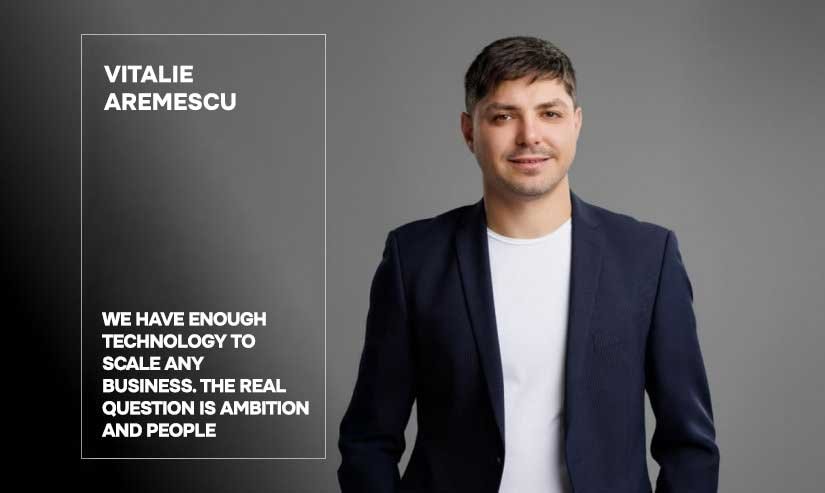

Interview with Vitalie Aremescu – Founder at EBS Integrator, digital transformation consultant
Four years ago, when we had our first interview with Vitalie Aremescu, EBS Integrator had already entered international markets and grown beyond being just a large outsourcing company.
Since then, the company has expanded its portfolio of in-house projects. Vitalie’s positioning has also evolved—he's not only an entrepreneur but also a digital architect: someone who, in 2025, truly knows how to help businesses grow two, three, five times and beyond.
Vitalie, I remember that whenever I talked about you before, I always mentioned Global Database. That was one of your flagship products—a business database covering 195 countries that evolved into a full platform. Is it still a priority for you?
Absolutely. The project is still important to me. But I’ve stepped away from day-to-day operations—my partner is managing it now. The project is growing, but not scaling as fast as we’d like. So we’re still working on the strategy, trying to find our “magic pill.” The potential is there—our clients are large companies on the European market, and we’ve also entered the U.S. market. The product solves a very specific need—it provides access to information about businesses and markets, which is crucial for setting up sales processes.
You emphasized the word “scaling.” Is that something especially important to you?
It’s essential. Whether we’re talking about IT solutions I create at EBS Integrator, other partnerships, or my role as a digital architect—scalability is one of the key criteria for evaluating any project.
You mentioned partnerships. What kind of projects are you involved in?
We’re talking about partnerships across various industries—from e-commerce and retail to fintech and insurance. But since we value our client relationships, I’d rather not name names. At EBS, we’ve developed several solutions with different operating models. One I can mention is Fluence.Tax.
Tax sector?
Yes, we developed a mobile app for Romanian and Moldovan citizens officially working in Germany that helps them claim the tax refunds they’re legally entitled to. We’ve simplified the tax refund process as much as possible. Some users have received refunds of up to €10,000.
Are you monetizing the app through a subscription model?
Yes. It’s available to clients through a very affordable annual subscription.
Why only for clients from Romania and Moldova?
That’s part of our go-to-market strategy—start with a niche product to simplify early-stage growth. Now that the project is gaining momentum, we’re working on scaling it to other ethnic groups who, due to language barriers and being new to Germany, struggle to access the tax benefits they’re entitled to. And we’re looking at expanding to other countries—Spain, Portugal, France. This requires complex integrations with various public data systems, but that’s something we know how to do. Global Database taught us a lot.
Have you added any new products to your company’s portfolio? What is EBS Integrator working on now?
We’re expanding our capabilities in line with the global trend of digital transformation. Over the last few years, I’ve lived in Luxembourg with my family and had the chance to observe what issues both large and mid-sized companies in Europe are facing.
After years of automating business processes, many companies now have numerous but disconnected data systems. Often, they’re not integrated at all. On top of that, a lot of the data required for management might not be collected at all—or the process is poorly automated, takes too long, and is full of errors. As a result, company owners and executives lack a unified, well-structured data bank about their own business, which makes decision-making and scaling extremely difficult.
And EBS Integrator solves that pain point?
We’ve built a platform that becomes the infrastructure for working with all of a company’s data—for collecting, analyzing, and using it. You could say this platform is about security, identity, logging, unified access, and managing all internal processes—from sales and HR to document management, with clear access rights and even tools to measure employee happiness.
Employee happiness?
Why not? We have such algorithms in our own company. The main thing is, it’s much easier to have an integrated platform with ready-to-use data than to waste time collecting and processing it manually for analysis. I don’t think anyone enjoys that kind of routine. It’s much more valuable to understand the data, analyze it, and make informed decisions.
Is this still an internal development, or do clients already use it?
The platform is already in use by 5 to 10 companies. Primarily in the financial sector, which has historically been our specialty. So far, it’s been implemented in several microfinance institutions and two Moldovan banks. Among our clients are also traders and one crypto platform.
So the product is already on an international level?
We’re already working with the platform in Romania. But its architecture is universal, so we can deploy it in any country.
I get the feeling we haven’t yet covered all the areas EBS Integrator is involved in. I remember you were also active in fields like e-commerce and even EdTech?
And we’re still actively developing them. We’ve added logistics automation to our e-commerce projects. We’re running a project in the UK that automates warehouse operations by integrating hardware with databases. So now, alongside e-commerce, we’re also focusing on retail.
As for EdTech, we’ve been working for a long time on digitizing the entire student journey—from admission to graduation. Our latest EdTech project is a platform for educational companies. And we’re not stopping there. EdTech has many specializations and directions, and we continue exploring them with great interest.
Like Oxford English Club or Coursera?
You could use them as examples, but we’re not building a marketplace. We’ve built a platform for a specific school, team, or group of teachers. Video courses, subscriptions, mobile app, marketing, payments—it’s all integrated. All you have to focus on is the content. The platform handles all the tech. One current project on this platform is focused on parenting education. Raising a child in today’s world requires knowledge—and parents need to learn that “profession” too.
You’re very diversified. But right now I’m trying to find some common ground across all your client profiles…
I can help you with that. Especially since I now have experience not only as an entrepreneur. As a digital transformation expert, I often support companies at the strategic level—working on business models, goal-setting, choosing solutions. Sometimes as a board member, sometimes as a partner. My own team of business analysts is a huge asset here. We dig into the root of the problem and propose the path forward.
But back to your question—about the client profile. My typical client, whether it’s EBS Integrator’s or mine personally, is someone who wants to grow—who wants to take their business to 2x, 5x, or even 10x. And who is ready for radical changes in business processes to reach the next level. You know what question I now start every client conversation with?
What question?
“If you had access to all the technologies in the world, what would you do?” That’s where the transformation begins.
We don’t just plug into the tech side of transformation—we plug into the transformation of the business itself. That’s why we focus on long-term, strategic partnerships with our clients.


 Life Principles


