




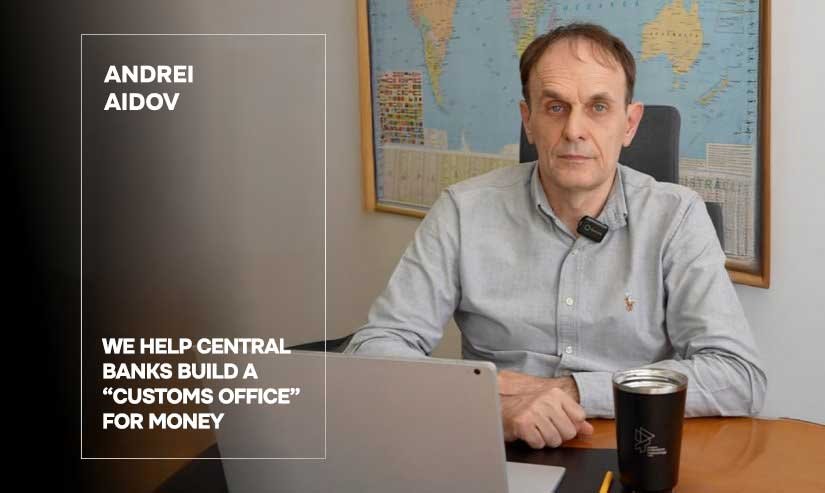

Interview with Andrei Aidov, CEO of QSystems
Before the interview, Andrei and I agreed to focus solely on QSystems’ new products. But products of this level don’t come out of thin air. So I want to briefly introduce Andrei and QSystems. That’s easy for me to do—I first interviewed Andrei back in 2019.
Andrei wrote his first banking software as a programmer for the foreign currency department of Mobiasbanca. In 1999, he became Head of IT at Banca de Economii, and over the next few years, he practically automated the entire bank from scratch.
By 2001, that experience led to the founding of QSystems. Before long, the company was not only working with Moldovan banks but also expanding to other markets. For instance, in 2006, it delivered several products to what was then just the newly formed “Tinkoff Credit Systems” bank.
In 2013, QSystems won the government tender to develop Moldova’s national electronic payment service, MPay. Twelve years on, QSystems is still the technical partner for MPay—a platform that handles billions of lei in transactions.
One of QSystems’ key areas of expertise has become international money transfer solutions, which we’ll discuss in detail in today’s interview.
Andrei, good afternoon. I’ve summed up all our previous conversations in the intro, so let’s jump right into QSystems’ current developments.
Did you include the story about how, back in university, I was exempt from almost every exam because I was a self-taught programmer writing custom programs for professors’ subjects—back when computers had just started becoming popular?
Sorry, I missed that one. But now that you’ve mentioned it, we’re definitely good to go. Which QSystems product should we start with?
CRP…
Spell it out for us.
It’s our internal name. Centralized Remittance Platform. A centralized system for money transfers. Our main clients are central banks, so the potential client base is pretty limited. Globally, there are only about 200 countries, give or take.
What problems does CRP solve? Why should central banks even be interested in this product?
The first task is oversight of international, non-bank money transfers. It’s the most vulnerable segment. When someone opens a bank account, they go through full verification. But in money transfer systems, it’s much simpler—show your ID and send the money. That creates serious risks—money laundering, terrorist financing, or sending funds from sanctioned countries.
Don’t central banks already have tools to monitor this?
They don’t. So they delegate oversight to commercial banks, who in turn rely on payment systems—many of which operate abroad, beyond the country’s jurisdiction. CRP eliminates this blind spot. Every transaction is verified before payout. The platform is integrated into the national financial architecture and gives the central bank full control tools. For example, our system uses two-phase logic: first comes verification, then payout. This lets authorities stop a transfer before it’s finalized. Not after the fact—“Oh, we found out Bin Laden got the money”—but before it even happens.
So that’s the first benefit of CRP. What’s the second?
It reduces credit and currency risks. In countries where remittances make up 10% or more of GDP, banks often pay out money before it arrives. That creates domestic liabilities not backed by actual funds. If exchange rates swing in the wrong direction, the losses to commercial banks can turn into a systemic threat for the country. CRP enables proper risk management in these cases.
And the third advantage?
It boosts the overall efficiency of the national banking system. Instead of 10–15 separate integrations with various systems, banks get a single interface, a unified message format. These transfers become part of broader business processes—you can automatically deposit a transfer into a savings account or use it to repay a loan.
These are what we call embedded payments—integrated transfers. They significantly cut transaction processing costs for banks and improve the customer experience.
A large-scale solution. Any real-world deployments yet?
Yes, our platform is already live in three countries: Uzbekistan, Tajikistan, and Armenia.
Is the central bank always the end customer?
It varies. In Tajikistan, the Central Bank itself operates the platform. That made the launch faster, as decisions were made directly. In Armenia, the Central Bank set up a separate company—a fully owned subsidiary—for this purpose. That took more time for setup, staffing, and legal procedures. In Uzbekistan, the operator is a private company that obtained a national license from the central bank.
Three countries, three implementation models. You've worked with all of them. In your view, which model is the most effective?
Even though implementation in Tajikistan was the fastest, I see several advantages in Uzbekistan’s model. It strikes a balance between business motivation and regulatory oversight. A private operator is driven to scale and earn revenue but operates within the boundaries set by the regulator.
Also, it’s important to be clear—the platform itself doesn’t handle the transfers. It connects all payment institutions, processes transactions, and acts as a gateway at the entry point. Inside QSystems, we like to joke that we’re building a border for money—and a customs office for the central bank.
How many transactions are currently processed through your platforms?
Right now, about 200,000 per month. But we expect to hit one million or more by the end of the year.
Do you provide ongoing support for the platforms?
Yes. The platform runs on the clients’ own servers. We maintain and update the software, but we don’t have access to the data. At the same time, regulatory authorities gain real-time transaction monitoring—rather than getting data one or two months after a payment is made.
We've gotten deep into CRP and haven’t even touched on QSystems' other products…
Let’s shift gears then—from central banks down to something closer to home: the comfort of apartment living.
Digital comfort, I assume?
Exactly. We’ve had a longstanding product called Factura.md—a B2B billing aggregator for managing payment data. Now, we’re working on a product for end users—residents and housing associations. We’ve created a new product simply called Factura. It’s a full digital ecosystem for property management.
What’s the potential market reach for this system?
If we’re talking apartment buildings—there are roughly 10,000 to 20,000 of them in Moldova. Technically, all of them could switch to a digital model.
What does the system offer?
Our goal is for residents to receive and pay bills online, participate in building votes, and have access to all documentation—charters, meeting minutes, decisions. They can request a repair—say, a plumber or electrician—and pay right within the system. They’ll get notifications like “painting scheduled tomorrow,” “a neighbor had a leak,” or “water will be shut off.”
So it’s not just for paying utilities?
No, it’s basically a super app for housing. An app that makes living easier. And it also helps fulfill legal requirements. By law, housing associations must make all documents publicly accessible—but no one explained how to actually do that. Our system solves that too.
Are any buildings already connected?
Yes. We started with buildings where we ourselves live. Right now, we’ve created a focus group, we’re gathering feedback, breaking down features into packages. Several housing associations are already connected.
Are you planning to expand beyond Moldova?
Absolutely. Moldova is a great MVP market—you can test things at a country-wide scale. But the system itself is universal. The same needs exist in every apartment building, in any country.
So, you brought up Factura to contrast the scale—with money transfer controls you’ve got maybe 200 potential clients globally, but here it could be the entire world?
You could put it that way. But when it comes to cross-border money transfers, we also have another product: the Direct Payment Network.
What’s the idea behind it?
It’s a platform that allows banks and payment operators to exchange cross-border money transfers directly, without relying on major international systems. We bring back the possibility of direct agreements: one side sends the money, the other pays it out.
So you’re not competing with Western Union, but offering an alternative?
Exactly. On routes with high volume and clear demand, there’s no reason to overpay intermediaries. We provide the infrastructure. Participants agree on rates, fees, and settlements. We just offer the standard and the gateway. It’s essentially a digital version of the old-school direct agency model—only now with APIs and full monitoring.
Do you have live use cases?
Yes. One current project involves a Swedish payment platform that’s using our solution to support money transfers for the Mongolian diaspora—spread across Europe and back home in Mongolia. They need to send money fast, transparently, and directly—and we provide the tech foundation for that.
And the money doesn’t go through you?
No. We’re the infrastructure. We don’t hold or touch the funds. Settlements happen directly between participants. That’s important for regulators. What’s even more crucial is that this platform can integrate national instant payment systems. Right now, every instant payment system is local—Romania has one, Moldova another, Brazil yet another. They don’t talk to each other. We’re currently building a bridge between two of them. This will be the first solution where someone can send money from one instant payment system to another—say, from a European country to Moldova—right from their app. And the whole thing takes just a few seconds.
That’s a fascinating direction. I’ve seen the stats on how fast instant payments are growing around the world. The issue of international integration is definitely going to be a hot topic. I want to start wrapping up—this has been a long interview. But I’d like to end on a personal note. Even when a regular business picks a tech partner for the long haul, they want to know who they’re dealing with. Because decisions in this space are often too serious to make blindly. And we’re not talking just any business—these are national banks making the call. What if they find out through your social media that you’re a diver and enjoy swimming with sharks? Would that be a point for or against working with you?
I think you’re overestimating my passion for diving. But honestly, I’d say it’s a point in my favor. Because diving isn’t about adrenaline—it’s about discipline. Underwater, everything has to be precise—how you breathe, how you move, how you coordinate with your partner. If you make a mistake, there’s no time to fix it. There’s no room for improvisation. It’s a great way to test how well you can stay in control when you’re outside your comfort zone.
And as strange as it might sound, diving sometimes helps you grasp the scale of things better. Imagine a unique trip to South Africa, where you get to observe the migration of massive fish shoals. On one side, you have thousands—maybe millions—of fish moving in perfect rhythm; on the other, predators like sharks and seabirds hunting them. It’s mesmerizing. Possibly one of the largest ecosystems on Earth. It’s a moment when you really feel scale and perspective. Then you come back to work and apply the same principles nature has honed over millions of years. Financial flows, too, need protection from predators.
In that case, I think I’ve got the perfect idea for a memorable presentation of your money transfer control platform—a diving expedition for central bank executives.
We tend to go with more traditional tender approaches, but I’ll pass your idea along to our marketing department.
And there’s something to be said for how everything you’ve built on the surface needs to function as seamlessly as those fish—no wasted movement, no commands—just... working.
That’s a great principle for any system product.
Exactly. When you're building a platform that will sit at the core of a country's financial infrastructure, it has to function under any conditions. Even when everything around it changes—it has to remain stable. This isn’t about ambition. It’s about responsibility.


 Life Principles


