




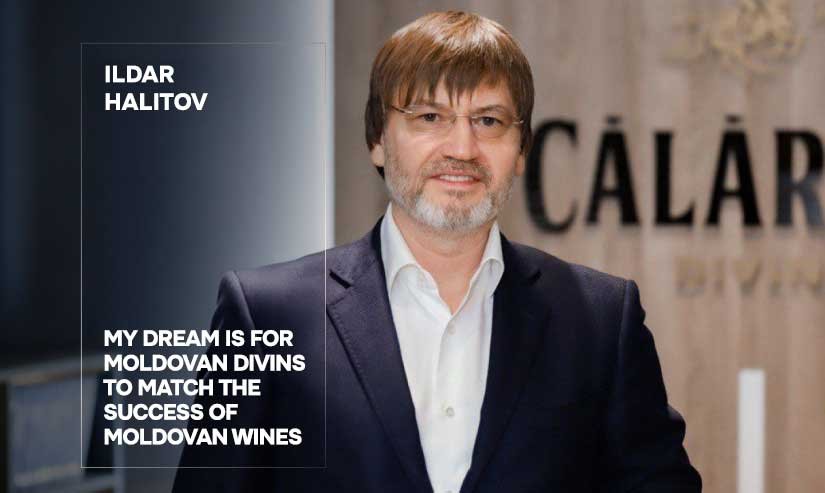

Interview with Ildar Halitov, owner of Calarasi Divin
I had already packed away my recorder when Ildar Halitov drifted back in memory to his early days as director of Calarasi Divin. But the picture he painted was so vivid, I’ll take the liberty of retelling it:
“…this was 18 years ago, in 2006. The factory left a mixed impression. On one hand, it had a unique stock of distillates and blends — the oldest of which was about to turn 40 in a year. On the other hand — there were only two old computers across the entire plant, the vineyard map wasn’t on paper, it was only in the head of the chief agronomist, shipping and bottling were done not by plan but by gut feeling, something like: ‘…eh, probably this many boxes should do…’. All buyers paid the same price — whether it was someone picking up one bottle of divin for themselves, or a wholesaler ordering several pallets. And then there were strict obligations from the government to the new owner regarding production reorganization and vineyard planting.”
That was 18 years ago.
Now, just one detail: since Ildar came to Calarasi Divin, around 400 hectares of vineyards have been planted. Today, Calarasi Divin is the only producer in Moldova that supplies its entire divin production with grapes grown on its own land. And those spirits that were 39 years old “back then” are now the base of a 50-year-old divin — and soon, of one aged 60.
Now, the interview. The story is definitely worth telling.
Ildar, good afternoon. First question that comes to mind — “Ildar Halitov”? Were you born in Moldova, or did you move here?
I’m a Tatar by birth. I was born in Kazan in 1966, into a family of two engineers — both my parents graduated from the Chemical Technology Institute, and that’s actually where they met.
It’s nearly 2,000 kilometers from Chisinau to Kazan. How did you end up in Moldova?
You’ll probably smile, but Moldova started for me with the fairy tale about Guguta’s Hat. My aunt, a full-blooded Tatar, gave it to me. I don’t know how the book ended up with her, but I read it to the point it was falling apart. That’s when I formed this image of Moldova as some kind of magical land...
If you ever shoot a documentary about Calarasi Divin, that’s a perfect way to open it — “It all started like a fairy tale...”
And everything after that was unusual too. Of course, as a schoolboy in Kazan, I had no idea I’d one day live in Moldova. But chance stepped in — more than once. First, totally randomly, I was sent with three other schoolkids to an all-Union pioneer gathering in Moldova, in Causeni. This was back in the ‘70s. We stayed with Moldovan families, and I came back with memories of huge, juicy apples and my first sip of wine, which they let me try.
After school, I enrolled in a military academy and was later assigned to Chisinau (fate again!), and then served in Bender. That’s also where I left the army. I returned to Kazan for a while, but Moldova pulled me back in.
What year was that?
1997. I chose Chisinau. I had no connections, didn’t speak the language, didn’t have residency — everything came with time. I got a job at a tire repair plant. My salary, I still remember, was 340 lei a month, lunch in the factory cafeteria was 10 lei, a pack of good cigarettes — 10 lei.
A year later I quit and found a job at a company that bottled and sold wine. It was a small company, so I was the “department head” without a department. I did pretty much everything, including overseeing the bottling at the facility we worked with. From there, I ended up at the well-known Dionis Club.
I remember that company! It had an office in “Kenford” and was shipping millions of bottles to Russia every year!
I can give you more exact numbers. In 2002 I was executive director of the winery in Vulcanesti, which belonged to Dionis Club. We were shipping to Russia by trainloads — sometimes one or two trainloads a week. At peak times — up to 10–12 trainloads a month. That’s up to 2 million bottles a month.
And then — the wine embargo in 2006!
Yes, and then the embargo. For a while, I managed a project relocating wine and brandy bottling to Ukraine, but eventually I quit. And that same year, in 2006, I became director of Calarasi Divin.
You were appointed director, not the owner?
Of course not. Back then, I was still just an employee. Calarasi Divin had recently been privatized by MMVZ — the Moscow Wine-Making Plant, a subsidiary of Bank of Moscow. At the time, the bank was buying up dozens of companies not only across the CIS, but all over the world. I already had a good understanding of Moldovan production, so I was approved as director of Calarasi Divin.
I was given a very clear set of tasks. The company had been purchased, but the shares were frozen until a long list of obligations was fulfilled. Investments, vineyard planting, maintaining the company’s core activity, increasing working capital, obtaining ISO certification — the list went on for pages. I was basically living at the factory, but we got everything done. You could say it was a textbook example of how privatization should work. The shares were unfrozen, and Calarasi Divin set out on its new, independent path.
At the same time, I managed to find time to earn a second degree at ASEM, in Business and Administration, and then a master’s in Banking and Finance. So it was a very intense period in my life.
That's quite a story. But clearly, there’s another chapter between being an employee and becoming the owner of the company…
In 2013, Bank of Moscow’s leadership changed, and the bank decided to sell off all non-core assets — starting with those outside of Russia. That’s when some Georgian businessmen started showing interest in Calarasi Divin. More precisely, they weren’t after the factory itself, but the distillates and blends — they wanted to move them to Georgia. In fact, two of their representatives were already at the plant, and they had sealed and locked down the entire storage facility.
This is where things heat up…
I managed to seize the initiative. The Georgians had some delays with their deal, and I was able to convince the shareholder representatives to sell the factory to me. I had to take out a loan using the plant as collateral, but I knew the company inside and out. I understood its potential and believed in Calarasi Divin’s future. So in the end, I preserved the legacy of the Georgian Sarajishvili for Moldova — and it could’ve gone the way of Vismos or Nis-Struguras, which no longer exist.
The legacy of Sarajishvili?
Oh! That’s a story in itself. Do you know how old Calarasi Divin is?
Honestly — no idea.
The factory was founded in either 1895 or 1896 by the Georgian entrepreneur and scientist David Sarajishvili. The scale of his legacy is astonishing. He was friends with Jean-Baptiste Camus, the founder of the Camus Cognac House, who advised him throughout his life. From 1885 to 1896, Sarajishvili opened cognac distilleries in Tbilisi, Yerevan, Calarasi, and Baku. He chose Calarasi because the soil composition, average temperatures, and climate closely matched those of France. So it’s not an exaggeration to say that the founder of Camus had an indirect hand in the creation of Calarasi Divin.
That’s a story you should tell more often. It’s worth it. So, fast-forwarding — you became the owner of the factory…
On July 3, 2014. We’ll be celebrating the 10-year anniversary soon, actually. Over these ten years, I haven’t yet invested in “glamour” — we haven’t rebuilt the production halls or added a restaurant or hotel. But we have invested in vineyards, equipment, the bottling line, and the primary production process. It’s not flashy, but I can be confident in the quality of what we produce. I’m proud to say that for any tasting, we just pull bottles off the shelf — and what we send to competitions comes from the same batches we sell in stores.
What’s your current production volume?
Let me start from the base of the pyramid. We harvest grapes from 525 to 530 hectares of vineyards. Depending on yield, that’s between 5,000 and 7,000 tons of grapes. At most, we sell 50–70 tons on special request, so essentially 99% of the grapes go into our own production. That translates to about 100,000 to 125,000 decaliters of base alcohol. That’s what we put into aging each year — and roughly what we sell annually. That’s around 2 to 2.5 million bottles per year. Almost all of it goes to the Moldovan market. Our exports are currently more about building image. We ship small batches to various countries, but there’s definitely potential there — and we plan to develop it.
If the Camus heirs were to visit Calarasi Divin — given that he was, in a way, connected to its founding — what would you highlight for them as the strengths of Calarasi Divin?
I’d start with the vineyards. We’re the only divin producer in Moldova that’s fully self-sufficient with our own grapes. In the Codru zone, we grow nine European white grape varieties. The quality is so high that the grapes could easily be used to make sparkling or still wines. So our distillate could satisfy even the most demanding blend master.
Our aging is done in 6,000 oak barrels — Hungarian, Bulgarian, Armenian, and French. We age over 25 types of divin ranging from 3 to 50 years. Bottling happens in-house, and distribution is handled by our own sales team and through our network of specialty shops.
As I mentioned, we’ve built a unique collection of distillates and blends. Our oldest spirit is from 1967 — it’s used in our blends aged over 30 years. Now we’re preparing a 60-year-old blend.
One important detail — our own water. We have our own well. The water is very soft, ideal for blending. At one point, we even sold water to partner companies we worked closely with.
And Calarasi Divin was the first company in Moldova to start producing under the IGP Divin label — in October 2022. That marked a new chapter for Moldovan brandy. Given the strict control involved in IGP Divin production, this is practically documentary proof for even the most skeptical customer that this divin was made entirely in Moldova, from Moldovan ingredients — in our case, exclusively from our own — and under strict government oversight.
That would definitely make an impression…
Still, I’d invite the Camus family in a few more years. Give us 2–3 years, 3–5 million more euros, and we’ll wrap up our investments into the primary production. Then we’ll focus on aesthetics. Moldova is becoming more and more attractive for wine tourism. Integration into the EU will only speed that up. We want Calarasi Divin to be part of that — to have a strong tourism component. Especially since the Codru region is nearby — it’s one of the most beautiful parts of the country, just an hour from the capital. We have everything needed to appeal to both domestic and foreign visitors.
Since we’re talking about plans — what are your future goals?
Divin production is a long game. Right now, we have a huge advantage — our collection of spirits and blends built up over the years. But to make sure the company remains a leader in 50 years, we need to start laying down spirits today that our successors will be proud of in 2074.
The core identity of the company is sacred to us. Still, we’re considering using 5–10% of our grapes to produce sparkling and still wines — just to explore that side of things.
But the main plan — or rather, the goal — is to replicate for divin the kind of success Moldovan winemakers have achieved in recent years. What we produce is worthy of international recognition. Step by step, we’ll work toward making Calarasi Divin a source of national pride and one of Moldova’s defining symbols.


 Life Principles


